
Table of Contents
There is a primal thrill in watching a cricket ball travel at speeds that the human eye can barely track. For decades, the quest for pure, unadulterated pace has been the ultimate arms race in the cricketing world. While spin is an art of deception and medium pace is a game of patience, express fast bowling is an act of intimidation. It is about a bowler pushing their body to the absolute limit to hurl a leather projectile at over 150 kilometres per hour.
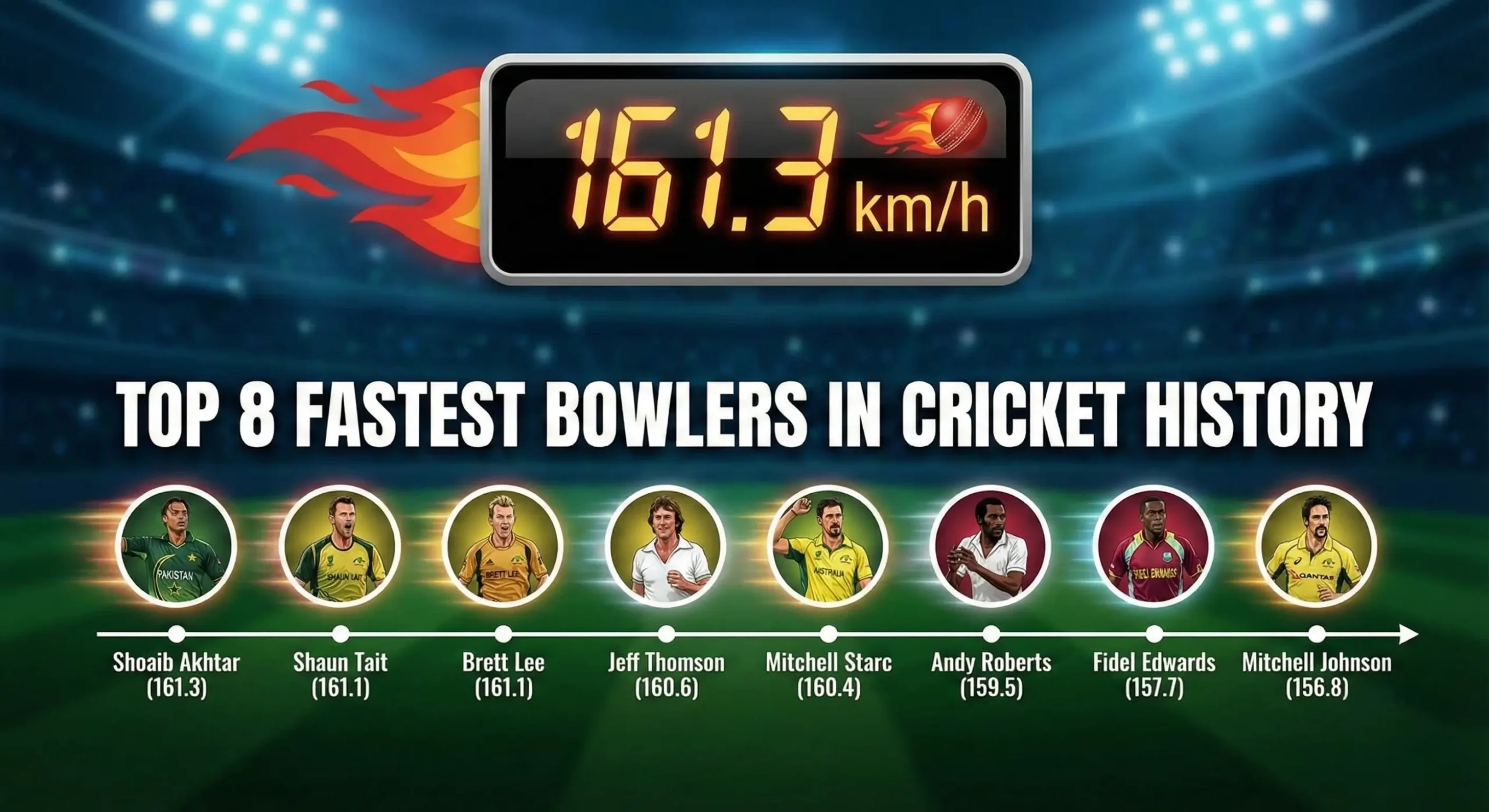
As we navigate through 2026, the technology used to measure these speeds has become incredibly precise, yet the records set by the legends of the past still stand as monumental achievements. Whether it was the raw aggression of the 1970s or the scientifically optimized run-ups of the modern era, these speedsters changed the way the game is played. In this article, we look at the definitive list of the fastest bowlers in cricket history, ranked by their highest recorded speeds.
Understanding these records requires more than just looking at a number on a screen. It involves appreciating the physical toll, the perfect mechanics, and the sheer bravery it takes to bowl at such velocities. If you have ever wondered who truly holds the title of the fastest to ever grace the pitch, this deep dive is for you.
1. Shoaib Akhtar (Pakistan) – 161.3 km/h
Known universally as the “Rawalpindi Express,” Shoaib Akhtar remains the undisputed king of pace. His record-breaking delivery occurred during the 2003 ICC World Cup in a match against England. On the final ball of his over to Nick Knight, the speed gun flashed a staggering 161.3 km/h (100.23 mph). It was the first time the 100 mph barrier was officially broken in international cricket.
Akhtar’s action was a marvel of biomechanics—a long, rhythmic run-up culminating in an explosive delivery stride and a lightning-fast arm through the air. While he faced numerous injuries throughout his career, his peak years were defined by a brand of bowling that was as theatrical as it was dangerous. Even today, over two decades later, no one has surpassed his mark, making it one of the most resilient records in all of sports.
2. Shaun Tait (Australia) – 161.1 km/h
Shaun Tait, often referred to as “The Wild Thing,” was a bowler who prioritised raw speed over almost everything else. His fastest delivery was clocked at 161.1 km/h (100.1 mph) against England at Lord’s in 2010. Tait used an unorthodox, slingy action that made his deliveries exceptionally difficult to pick up for batters.
Unlike many of his peers, Tait was primarily a short-format specialist. His body was built for explosive bursts rather than the long-haul requirements of Test cricket. Although his career was hampered by recurring injuries, during his brief spells on the field, he was arguably the most frightening prospect in world cricket. When Shaun Tait was in rhythm, the speed gun was the only thing moving faster than the ball.
3. Brett Lee (Australia) – 161.1 km/h
Brett Lee shares the second spot on this list with his compatriot Shaun Tait, having also touched the 161.1 km/h mark during an ODI against New Zealand in 2005. Lee was the poster boy for fast bowling in the early 2000s, combining a classical, beautiful bowling action with ferocious pace and a relentless competitive spirit.
What set Lee apart from many other “express” bowlers was his longevity and athletic fitness. He maintained high speeds across all three formats for over a decade. His ability to bowl toe-crushing yorkers at 155 km/h made him a nightmare in the death overs. Lee wasn’t just about speed; he was a craftsman who understood how to use that pace to set up batters and take wickets consistently at the highest level.
4. Jeff Thomson (Australia) – 160.6 km/h
To understand the legend of Jeff Thomson, one has to look back at the mid-1970s. Long before modern digital speed guns, Thomson was terrifying batters with a slinging action that seemed to defy the laws of physics. In 1975, during a dedicated high-speed study, he was clocked at 160.6 km/h (99.8 mph). Many contemporaries, including Vivian Richards, swear that “Thommo” was faster than anyone they ever faced later in their careers.
Thomson’s pace was so extreme that his wicketkeeper often stood halfway to the boundary. He didn’t rely on swing or seam; he relied on pure, terrifying velocity and a bouncer that aimed for the throat. Along with Dennis Lillee, he formed perhaps the most feared bowling partnership in the history of the sport, proving that even without modern training methods, the human body is capable of incredible feats of power.
5. Mitchell Starc (Australia) – 160.4 km/h
The modern torchbearer for Australian pace, Mitchell Starc, earned his place on this list during a Test match against New Zealand at the WACA in 2015. He unleashed a thunderbolt that reached 160.4 km/h (99.7 mph). As a tall left-armer, Starc brings a unique angle to the crease, making his 160 km/h deliveries feel even faster as they zip back into the right-handed batter.
Starc has been a vital component of Australia’s success in world tournaments, particularly the 2015 and 2023 World Cups. His ability to maintain such high speeds in red-ball cricket is a testament to his conditioning. While he has occasionally been clocked higher in “glitchy” speed gun moments, his 160.4 km/h mark is the officially recognized peak of his illustrious career.
6. Andy Roberts (West Indies) – 159.5 km/h
The leader of the legendary West Indian pace quartet of the 1970s and 80s, Andy Roberts was the “thinking man’s” fast bowler. While he had a lethal slower ball and impeccable control, his top-end speed was staggering. He was clocked at 159.5 km/h (99.1 mph) during a match against Australia in 1975. Roberts was known for having two different bouncers: one at a brisk pace and another at maximum velocity designed to catch the batter off-guard.
His contribution to the International Cricket Council Hall of Fame is well-documented, as he paved the way for future legends like Malcolm Marshall and Michael Holding. Roberts proved that express pace, when combined with a strategic mind, could dominate world cricket for an entire generation.
7. Fidel Edwards (West Indies) – 157.7 km/h
Fidel Edwards burst onto the scene in the early 2000s with a very low, slinging action reminiscent of Jeff Thomson. In 2003, during a match against South Africa, he was clocked at 157.7 km/h (98.0 mph). Edwards’ action allowed him to generate immense skidding pace off the pitch, making his deliveries reach the batter much quicker than they expected.
Although injuries eventually took their toll, Edwards remained a genuine threat in both international and franchise cricket for years. His ability to reverse swing the ball at speeds exceeding 150 km/h made him particularly lethal on the abrasive pitches of the subcontinent. He remains one of the fastest bowlers to ever represent the West Indies in the post-golden era.
8. Mitchell Johnson (Australia) – 156.8 km/h
Mitchell Johnson’s peak was perhaps the most dominant period any fast bowler has ever had. During the 2013-14 Ashes series, he wasn’t just fast; he was psychologically damaging. His highest recorded speed of 156.8 km/h (97.4 mph) came during that iconic series against England. Johnson combined raw left-arm pace with a mean streak that reminded many of the old-school intimidators.
What made Johnson special was his ability to maintain these speeds over long spells in Test matches. He could bowl four or five overs at an average speed of 150 km/h, eventually wearing down even the most technically sound batters. His performance in that Ashes series remains a benchmark for what an express fast bowler can achieve when everything—rhythm, fitness, and mindset—clicks at once.
Common Mistakes in Measuring Bowling Speed
When discussing the fastest bowlers in cricket history, fans often fall into certain traps or misunderstandings. Here are the most common challenges when interpreting speed data:
- Speed Gun Discrepancies: Not all speed guns are calibrated equally. Older technology measured speed as the ball reached the batter, whereas modern technology measures it at the point of release. This makes comparing Jeff Thomson to Mitchell Starc a bit like comparing apples to oranges.
- Point of Measurement: A ball loses about 10-15% of its speed after pitching. A 160 km/h delivery out of the hand might reach the batter at “only” 140 km/h. Beginners often confuse release speed with the speed at which the ball hits the bat.
- Broadcasting Glitches: Occasionally, a speed gun will malfunction and show an impossible number (like 175 km/h). These are usually errors in the software or a reading of a passing bird or insect. It is important to wait for official confirmation before believing a new world record has been set.
- The “Wind Aid” Factor: Environmental conditions like a strong tailwind can slightly boost a bowler’s recorded speed, but these are rarely adjusted in historical lists.
Best Practices for Developing Express Pace
If you are an aspiring fast bowler looking to climb the speed charts, it isn’t just about “bowling harder.” It is a calculated process involving several key pillars:
- Core and Lower Body Strength: Pace doesn’t come from the arm; it comes from the ground up. Strong legs and a stable core allow for better energy transfer through the crease.
- The “Front-Foot Landing”: Ensuring a strong, braced front leg at the point of delivery is the secret to generating maximum torque. If the front knee bends too much, you lose a significant amount of potential speed.
- Efficient Run-up Rhythm: A run-up should be a gradual build-up of momentum, not a flat-out sprint from the start. Finding your “rhythm” ensures you hit the crease with the perfect amount of controlled energy.
- Shoulder and Arm Flexibility: High-velocity bowling requires a wide range of motion. Consistent stretching and mobility work are essential to prevent the injuries that often cut speedsters’ careers short.
- Recovery Management: Express bowling is violent on the body. Professional fast bowlers follow strict “over-count” limits and prioritise sleep and nutrition to allow their muscle fibres to repair.
Final Thoughts
The quest for the fastest ball in cricket history is a journey through some of the most iconic moments in the sport. From the dusty pitches of the 70s to the high-tech stadiums of today, the men on this list have pushed the boundaries of human performance. While Shoaib Akhtar still holds the crown, the emergence of new talents like Mayank Yadav and Lockie Ferguson suggests that the 161.3 km/h record might one day be under threat.
Ultimately, fast bowling is about more than just the number on the scoreboard. It is about the courage to run in, over after over, and give everything to the cause. As technology continues to evolve, our appreciation for these speed kings only grows deeper. They remind us that cricket, at its heart, is a battle of skill, will, and sometimes, terrifying velocity.