
Table of Contents
If you feel like the economic forecasts of the last few years were written by a group of highly educated dart-throwing monkeys, you are not alone. As we navigate the first quarter of 2026, the financial landscape remains a complex puzzle of fluctuating interest rates, rapid technological integration, and shifting geopolitical alliances. The strategies that worked in the era of cheap money are now gathering dust in the archives of financial history.
The 2026 economy is characterised by “sticky” inflation and a labour market that is simultaneously tight and undergoing massive AI-driven displacement. For the individual investor, the goal has shifted from chasing speculative unicorns to building a resilient, adaptable fortress. This is not about timing the market perfectly; it is about having a plan that survives when the market decides to have a bad day or a bad year.
This article provides a roadmap for those looking to secure their financial future amidst these headwinds. We will move beyond the basic advice of “buy low and sell high” to look at sophisticated, yet accessible, investment strategies designed for the unique pressures of the current year. Whether you are a seasoned investor or just starting to look at your 401(k) with a bit of trepidation, these insights will help you steady the ship.
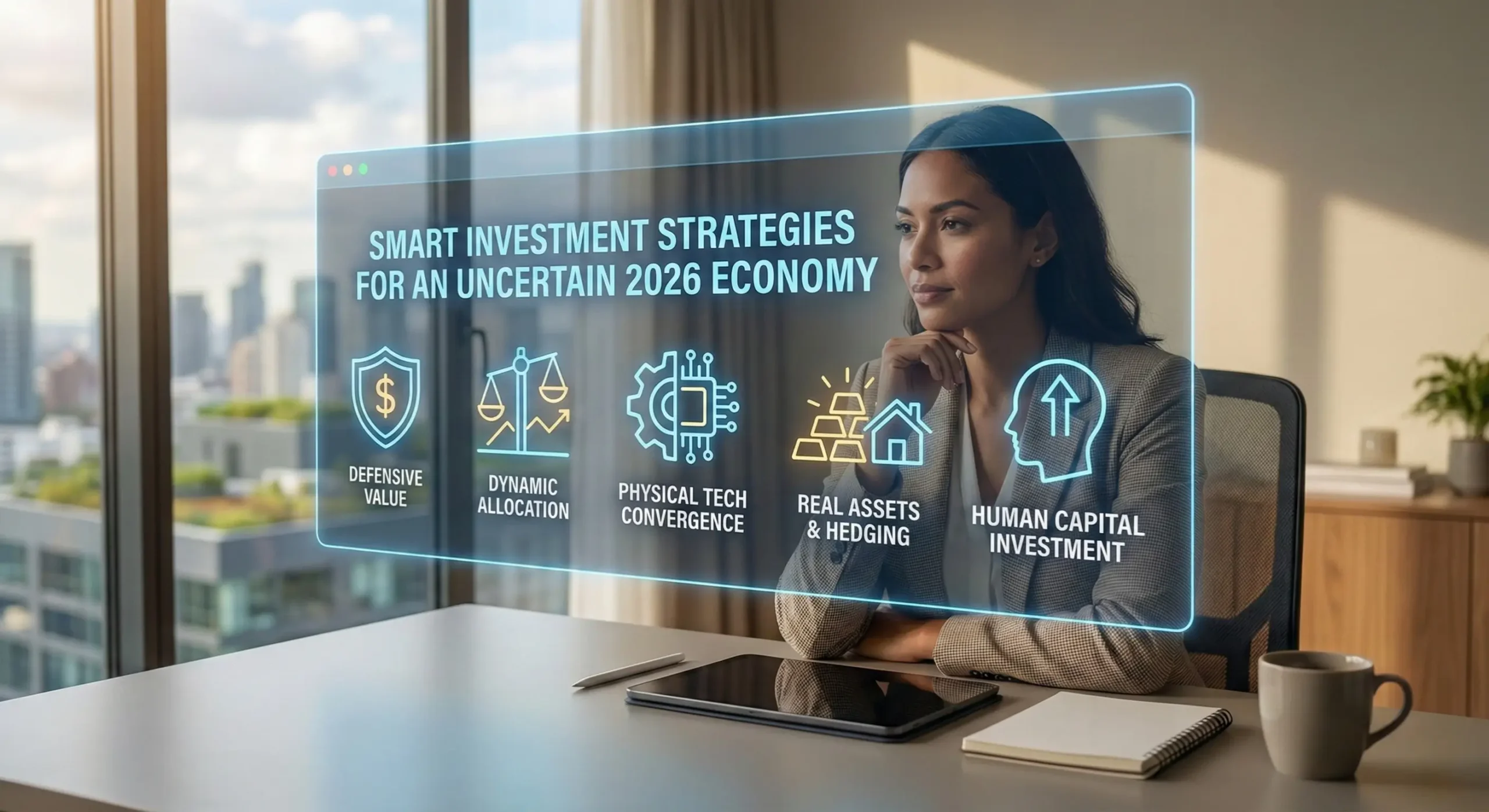
1. The Resurgence of Defensive Value Investing
In 2026, the pendulum has swung back toward fundamental reality. For much of the early 2020s, investors were enamoured with “growth at any cost.” Today, the cost of capital is too high for such luxuries. Defensive value investing focuses on companies with robust balance sheets, consistent cash flows, and what legendary investors call a wide economic moat.
These are the companies that provide the plumbing of civilisation. They offer products and services that people cannot, or will not, cut from their budgets, even when the economy stutters. Think of consumer staples, healthcare providers, and utility companies. In an uncertain economy, these stocks act as a stabilising force in your portfolio, often providing dividends that act as a psychological and financial cushion during downturns.
Focusing on Quality over Hype
The key to this strategy is looking for high “Return on Invested Capital” (ROIC). A company that can efficiently turn its capital into profit without relying on endless debt is a winner in 2026. Avoid companies that are “pre-revenue” or those that rely on creative accounting to show a profit. In this environment, cash is not just king; it is the entire royal court.
Dividend Aristocrats as a Buffer
Look toward companies that have increased their dividends for 25 consecutive years or more. These “Dividend Aristocrats” have survived previous recessions and interest rate hikes. Their ability to consistently return value to shareholders is a testament to their operational resilience, making them a cornerstone for any defensive investment strategy.
2. Tactical and Dynamic Asset Allocation
The traditional 60/40 portfolio—60 percent stocks and 40 percent bonds—has faced significant criticism lately. In 2026, a static allocation is often too slow to react to the rapid-fire shifts in global trade and monetary policy. Instead, smart investors are moving toward tactical and dynamic asset allocation.
This does not mean day trading or making impulsive moves based on the latest news cycle. Rather, it involves setting a baseline allocation and then making deliberate, data-driven adjustments based on broader economic cycles. If the International Monetary Fund signals a significant slowdown in a specific region, a tactical investor might temporarily reduce exposure to that region’s equities in favour of short-term government debt or commodities.
The Role of Alternatives
A dynamic strategy often includes a third bucket: alternatives. This can include private equity, real estate, or even high-end collectables. By adding assets that do not move in perfect lockstep with the stock market, you reduce your overall portfolio volatility. In 2026, having 10 to 15 percent of your portfolio in non-correlated assets is a savvy way to hedge against systemic risk.
Rebalancing with Discipline
The most important part of a dynamic strategy is the rebalancing act. When one asset class performs exceptionally well, your portfolio can become “top-heavy.” Rebalancing forces you to sell high and buy into assets that may be undervalued, ensuring your risk profile remains consistent regardless of market enthusiasm.
3. Investing in the “Physical Tech” Convergence
We have moved past the era where “tech” meant just software and social media apps. In 2026, the most promising investment strategies involve the convergence of digital intelligence and physical infrastructure. This includes advanced manufacturing, smart grids, and the hardware required for the AI revolution.
The uncertainty in the current economy is often tied to the transition from old energy to new energy and the reshoring of manufacturing. Companies that are building the physical world using AI and robotics are in a unique position for growth. This is “tech you can touch,” and it is often more resilient to market shifts than pure-play software companies that face low barriers to entry.
Sustainable Infrastructure
As governments globally commit to upgrading ageing infrastructure, massive amounts of capital are flowing into specialised construction and engineering firms. These are long-term contracts that provide predictable revenue streams, making them attractive for investors who want growth without the volatility of the latest Silicon Valley trend.
The Semiconductor Backbone
While the hardware cycle can be lumpy, the long-term demand for high-end processing power remains insatiable. Investing in the leaders of the semiconductor space—and their suppliers—is essentially a bet on the continued digitisation of the global economy. It is a fundamental play on the infrastructure of the future.
4. Inflation Hedging with Real Assets
Inflation in 2026 has proven to be more persistent than many anticipated. Standard savings accounts, even those with “high interest,” often fail to keep pace with the rising cost of living after taxes are considered. To combat this, smart investment strategies must include a dedicated focus on real assets.
Real assets are physical items that have intrinsic value. Unlike a currency that can be printed, real assets are finite. This category includes real estate, precious metals, and essential commodities like copper or lithium. During periods of currency devaluation or economic instability, these assets tend to retain their purchasing power more effectively than paper assets.
The New Real Estate Reality
Investing in real estate in 2026 requires a more surgical approach than in the past. Residential property in “zoom towns” or regions with high climate resilience is becoming more valuable than traditional urban office space. Real Estate Investment Trusts (REITs) that focus on data centres or cold-storage warehouses are also seeing strong performance as the digital economy expands its physical footprint.
Commodities and the Energy Transition
The global shift toward electrification requires immense amounts of raw materials. Investing in the producers of these materials can serve as both an inflation hedge and a growth play. However, commodities can be volatile, so this strategy is best executed through broad-based exchange-traded funds (ETFs) rather than betting on a single mining company.
5. The Human Capital Hedge: Investing in Yourself
Perhaps the most overlooked of all investment strategies is the investment in your own “Human Capital.” In an economy where AI can now perform many mid-level cognitive tasks, the most valuable asset you own is your ability to adapt, lead, and solve complex problems. This is the only asset that the market cannot take away from you and that inflation cannot devalue.
In 2026, the rate of skills obsolescence is faster than ever. Allocating a portion of your financial resources toward education, certifications, or specialised coaching is a direct investment in your future earning potential. If your primary source of income is secure and growing, you can afford to be more patient and disciplined with your market investments.
Strategic Networking
Your network is a form of social capital that often yields higher returns than a brokerage account. In an uncertain economy, the best opportunities—be it a new job, a business partnership, or an insider investment tip—often come through personal connections. Spending time and money to attend industry conferences or participate in high-level mastermind groups is a legitimate investment activity.
Health as Wealth
It sounds cliché until you see the medical bills. Investing in your physical and mental health is a vital part of a long-term financial plan. High-performance individuals in 2026 view health as a prerequisite for wealth creation. Reduced medical costs and increased productivity are direct boosts to your lifetime net worth.
Common Mistakes and Challenges
Even the best investment strategies can be derailed by common psychological traps. The most prevalent mistake in 2026 is “recency bias”—the tendency to believe that what happened in the last six months will continue indefinitely. When the market is up, people take on too much risk; when it is down, they flee to the safety of cash at exactly the wrong time.
Another challenge is the “noise-to-signal” ratio. With AI-generated financial news saturating social media, it is easy to get caught up in a panic or a hype cycle. Many beginners fail because they mistake “activity” for “progress.” They feel the need to do something every time the market dips, leading to high transaction fees and poor tax efficiency. Understanding market volatility is essential to staying the course.
- Ignoring the impact of taxes and management fees on long-term returns.
- Failing to maintain an adequate emergency fund (at least 6-12 months in 2026).
- Over-concentrating in a single “sure thing” stock or sector.
- Allowing political opinions to dictate financial decisions.
Best Practices and Actionable Tips
To move from theory to practice, you need a checklist that keeps you grounded. These best practices are designed to be applied immediately, regardless of your portfolio size. The goal is to automate the mundane and focus your brainpower on the strategic.
- Automate Your Savings: Set up your accounts so that a portion of every paycheck is invested before you even see it. This removes the “decision fatigue” of saving.
- Review Your Risk Tolerance: Be honest about how much of a drop you can stomach. It is better to have a slightly lower return than to sell your entire portfolio in a midnight panic.
- Audit Your Expenses: In an uncertain economy, your savings rate is more important than your return rate. Cut the subscriptions and services you no longer use.
- Diversify Globally: Don’t suffer from “home country bias.” Ensure you have exposure to emerging markets that might be growing while developed markets stagnate.
- Read the Fine Print: Ensure you are utilising tax-advantaged accounts like IRAs or 401(k)s to their full potential.
Final Thoughts
The 2026 economy is certainly not for the faint of heart, but uncertainty is simply another word for opportunity. By focusing on defensive value, maintaining a dynamic allocation, and investing in both real assets and yourself, you turn volatility from a threat into a tool. The most successful investors are not those who predict the future, but those who are prepared for multiple versions of it.
As you move forward, remember that the best investment strategies are the ones you can actually stick to when things get uncomfortable. Don’t let the headlines distract you from your long-term retirement planning basics. Wealth is rarely built in a single brilliant stroke; it is grown through the steady, disciplined application of sound principles. Take a deep breath, look at your numbers, and take the first step toward a more secure 2026.