Table of Contents
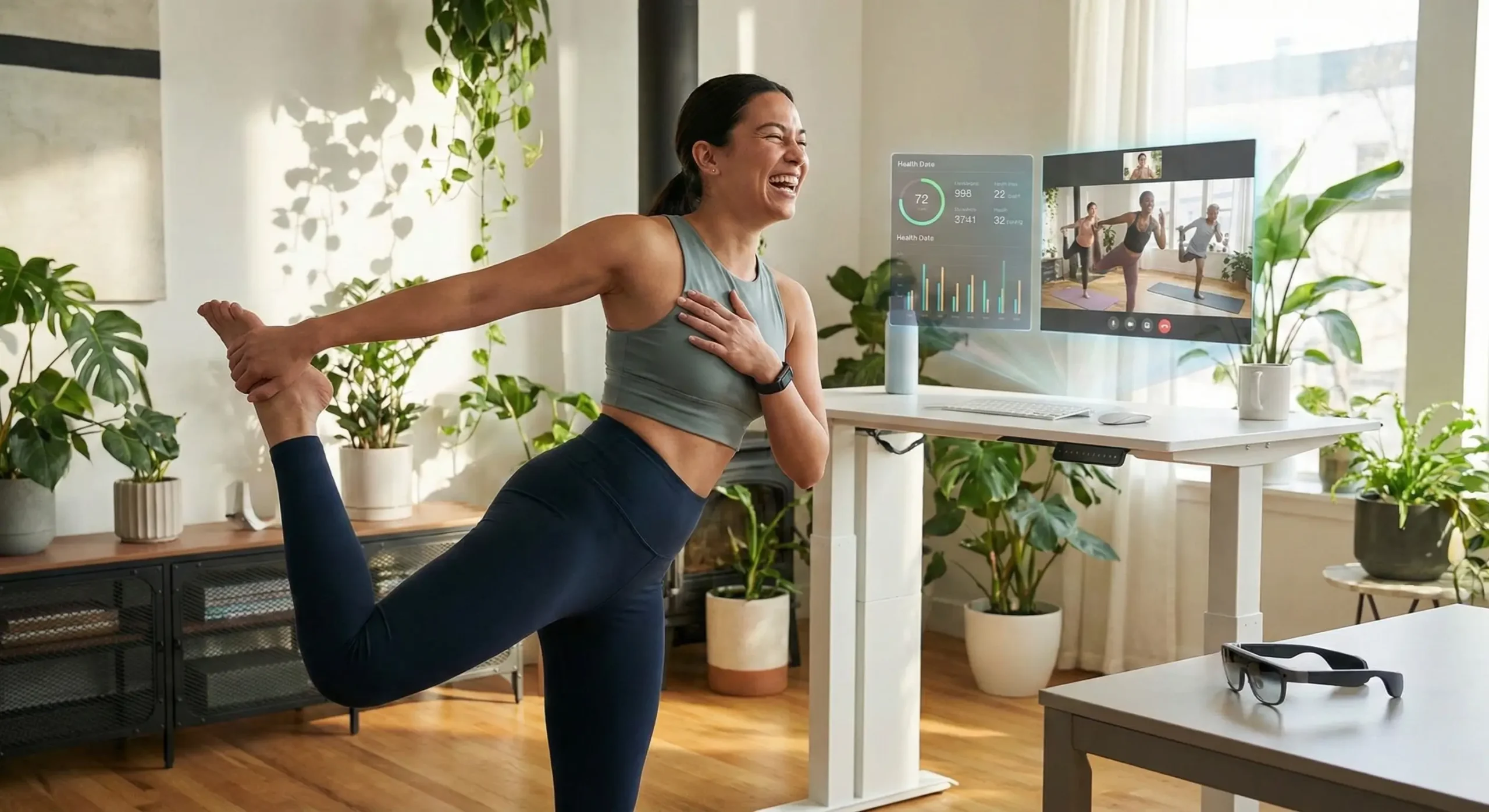
Staying healthy used to be a matter of showing up at a gym and lifting heavy objects until you felt tired. In 2026, the challenge has shifted from a lack of information to a surplus of it. Between smart glasses tracking your glucose and AI trainers critiquing your posture, the modern professional is often more exhausted by the data than the workout itself.
The secret to fitness this year is not found in more gadgets, but in better integration. As our work lives become increasingly digital and sedentary, the biological need for movement remains unchanged. We are essentially prehistoric software running on high-tech hardware, and that hardware requires a specific type of maintenance to avoid system errors.
If you want to stay fit in 2026, you must navigate a world designed for convenience at the expense of your vitality. This guide distils the complex noise of the current wellness industry into eight actionable strategies. We focus on what actually moves the needle for busy humans who want to feel capable, energetic, and resilient in a fast-paced economy.
1. Embrace the Era of Micro-Workouts
The traditional “gym hour” is becoming a luxury of the past. In 2026, the most successful fitness enthusiasts have adopted the micro-workout. This strategy involves breaking physical activity into short, intense bursts of 5 to 10 minutes spread throughout the day. This approach prevents the metabolic shutdown that occurs when sitting for eight hours straight.
Scientific research supported by organisations like the World Health Organisation suggests that cumulative movement is just as effective for cardiovascular health as a single long session. By integrating movement into your professional calendar, you eliminate the “I don’t have time” excuse that sabotages most fitness goals.
The “Meeting Interval” Strategy
Try performing two minutes of air squats or lunges between every virtual call. It sounds trivial, but by the end of a typical workday, you have completed twenty minutes of high-quality lower-body work without ever putting on gym clothes.
2. Prioritise Functional Strength Over Aesthetics
While looking good in a mirror is a pleasant side effect, the 2026 fitness philosophy is firmly rooted in functional strength. This means training your body to handle the demands of real life—carrying heavy groceries, sprinting for a train, or maintaining perfect posture during a three-hour deep-work session. We are seeing a move away from isolated muscle machines toward compound movements.
Functional fitness focuses on multi-joint exercises like deadlifts, pull-ups, and rotational movements. These exercises build “real-world” power and protect your joints from the repetitive strain injuries common in a tech-heavy lifestyle. When your body works as a single unit, you burn more calories and build a more resilient frame.
- Focus on “hinge” and “squat” patterns to protect the lower back.
- Incorporate unilateral (one-sided) training to fix muscle imbalances.
- Use kettlebells or sandbags to simulate the awkward weights found in daily life.
3. Master the Art of Biometric Mindfulness
By 2026, most of us are wearing some form of biometric tracker. However, the key to staying fit is moving from data collection to data interpretation. Instead of obsessing over reaching 10,000 steps, modern fitness involves monitoring your Heart Rate Variability (HRV) and recovery scores to decide how hard you should train today.
If your tracker shows a low recovery score due to poor sleep or high stress, a high-intensity interval session might do more harm than good. In these instances, a long walk or a restorative yoga session is the smarter “fitness” choice. Learning to listen to what the data is telling you about your internal state prevents burnout and chronic injury.
Understanding Your “Readiness Score”
Treat your daily readiness score as a guide, not a dictator. If the data says you are tired, but you feel amazing, go for it. But if the data confirms you are red-lining, have the discipline to scale back. Consistency beats intensity every single time.
4. Solve the Sedentary Paradox with Zone 2 Training
Many people fall into the trap of being “active couch potatoes”—working out intensely for an hour but remaining motionless for the other twenty-three. To stay fit in 2026, you must prioritise Zone 2 cardio. This is a steady-state exercise where you can still hold a conversation but feel your heart rate is elevated.
Zone 2 training improves mitochondrial health, which is the foundation of your energy levels. Walking at a brisk pace, easy cycling, or even vigorous gardening count. This type of movement clears the mental fog associated with “screen fatigue” and provides a metabolic base that makes your high-intensity workouts more effective.
5. The “Protein-First” Nutritional Framework
Nutrition in 2026 has moved away from restrictive dieting toward a “protein-first” mindset. As we age, maintaining muscle mass becomes the primary indicator of longevity. By ensuring every meal contains a high-quality protein source, you naturally regulate your appetite and provide the building blocks for muscle repair.
This approach simplifies decision-making in a world of endless food options. Instead of counting every calorie, you focus on the quality of your macronutrients. When you prioritise protein and fibre, you are less likely to reach for processed snacks that cause the energy crashes so common in a modern workday.
Practical Meal Planning
Start your day with at least 30 grams of protein. This stabilises your blood sugar and prevents the mid-afternoon “vending machine hunt.” It is a simple shift that yields massive results in body composition and cognitive clarity.
6. Leverage Social Fitness Communities
Isolation is a quiet health crisis in 2026. Because so much of our life is remote, fitness has become a primary vehicle for social connection. Whether it is a local run club, a digital rowing league, or a neighbourhood padel tournament, adding a social element to your fitness routine increases adherence dramatically.
We are biologically wired to seek the approval and companionship of our peers. When you know a group of people is expecting you at 7:00 AM, the friction of getting out of bed vanishes. Fitness becomes something you do with people, rather than a chore you do to yourself.
7. Optimise for “Circadian Fitness”
In 2026, we understand that when you do something is almost as important as what you do. Circadian fitness involves aligning your physical activity with your body’s natural internal clock. Exposure to morning sunlight and movement helps set your cortisol and melatonin cycles, leading to better sleep and higher daytime energy.
Avoid high-intensity workouts late at night, as the spike in body temperature and adrenaline can disrupt your sleep architecture. Instead, aim for challenging sessions in the morning or early afternoon when your grip strength and body temperature naturally peak. A fit body is impossible without high-quality sleep.
The Morning Light Walk
A ten-minute walk outside, within thirty minutes of waking up, is perhaps the highest-ROI fitness habit you can adopt in 2026. It triggers the “wake up” signals in your brain and prepares your metabolism for the day ahead.
8. Mental Resilience as a Physical Attribute
The line between mental and physical fitness has blurred completely. In 2026, staying fit requires a “nervous system budget.” If your job is high-stress, your workouts should occasionally be low-stress to compensate. We are seeing a rise in “breathwork training” as a legitimate part of a fitness regimen.
Training your ability to stay calm under physical load—such as during a heavy lift or a fast run—translates directly to staying calm during a stressful boardroom presentation. Physical fitness is the training ground for psychological grit. If you can control your breathing when your lungs are burning, you can control your reaction when a deadline is looming.
Common Mistakes and Challenges
The most common mistake people make in 2026 is “optimization paralysis.” They spend so much time researching the perfect supplement, the best shoes, or the latest AI workout app that they never actually break a sweat. Complexity is the enemy of execution. If you find yourself spending more time on your fitness dashboard than on your feet, it is time to simplify.
Another significant challenge is the “all-or-nothing” mentality. People often wait for the “perfect” time to start a fitness journey—after the project is done, after the holidays, or when they feel more energetic. In a modern lifestyle, the perfect time does not exist. The challenge is learning to be “fit enough” during your busiest weeks so that you don’t lose all your progress.
- Relying solely on “willpower” instead of designing a movement-friendly environment.
- Comparing your progress to highly curated (and often filtered) digital influencers.
- Neglecting mobility and flexibility in favor of purely “hard” training.
- Underestimating the negative impact of “ultra-processed” health foods.
Best Practices and Actionable Tips
To stay fit in 2026, you need a system that survives your worst days, not just your best ones. Use the following checklist to ensure your lifestyle supports your health goals without requiring a total personality transplant.
- The 10-Minute Rule: If you feel like skipping a workout, commit to just 10 minutes. Usually, once you start, you will finish. If you don’t, 10 minutes is still better than zero.
- Keep Gear Accessible: Have your workout clothes and equipment visible. Reducing the “visual friction” of starting a workout is a proven psychological hack.
- Standardize Your Fuel: Have 2 or 3 “go-to” healthy meals that require zero thought to prepare. This saves your decision-making energy for your work.
- Walk and Talk: Whenever possible, take your voice calls while walking. It is a seamless way to add 3,000 to 5,000 steps to your day.
- Audit Your Sleep Hygiene: Use blackout curtains and cool room temperatures. No amount of exercise can outrun a chronic sleep deficit.
Final Thoughts
Staying fit in 2026 is not about being an elite athlete; it is about being a functional human in a world that encourages you to be a stationary observer. By focusing on micro-workouts, functional strength, and the “protein-first” mindset, you create a sustainable foundation that doesn’t feel like a second job. Your health is the platform upon which all your other successes are built.
The modern lifestyle presents unique challenges, but it also offers incredible tools for those who use them wisely. Move because you can, eat to nourish your potential, and remember that the best workout is the one that actually happens. Start small, stay consistent, and let your results speak for themselves.