
Table of Contents
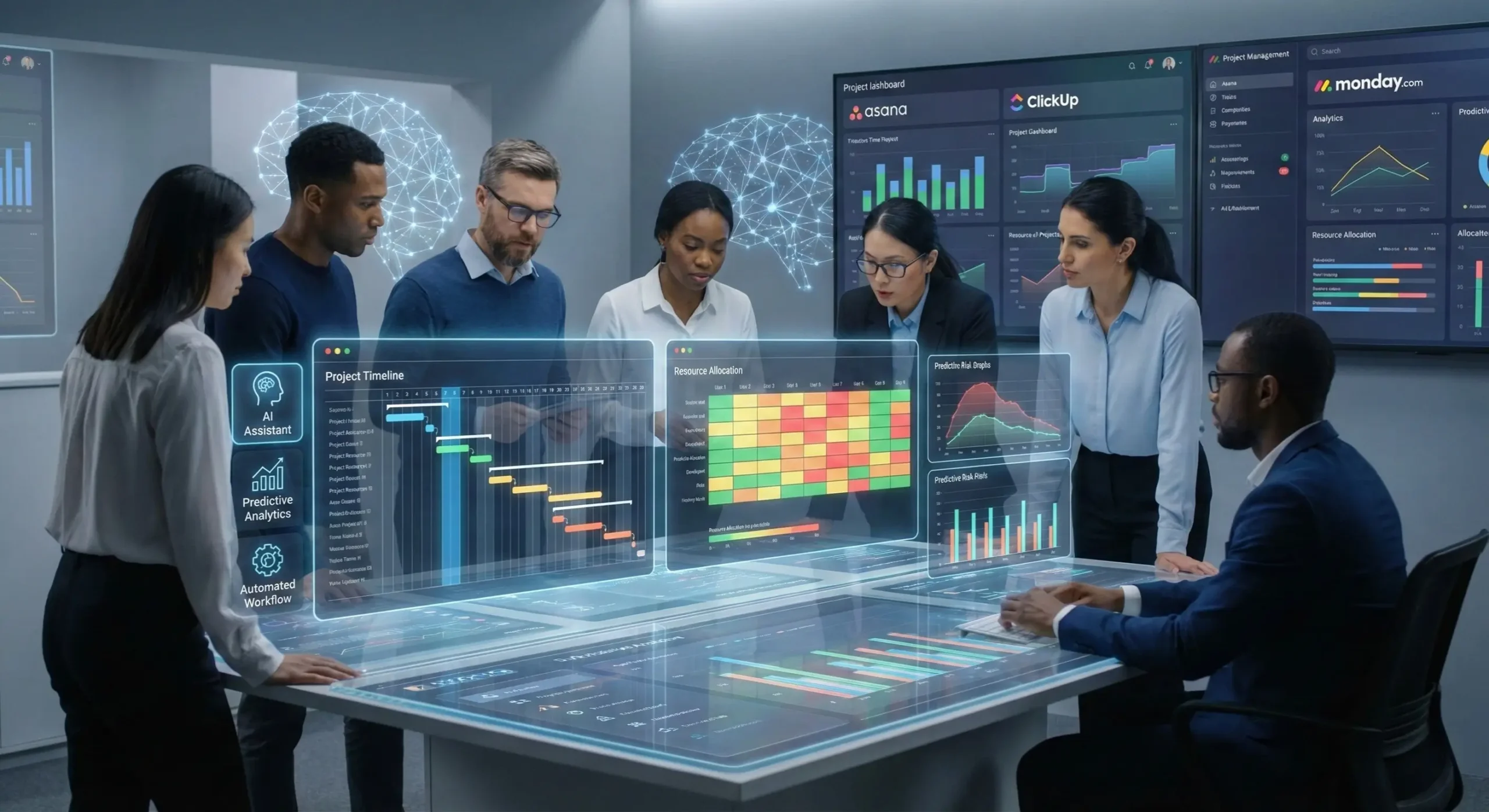
There was a time, not so long ago, when a project manager’s greatest fear was a corrupted Excel spreadsheet or a team member forgetting to update a status column. Fast forward to 2026, and the landscape has shifted. If you are still manually chasing people for updates or trying to guess when a project might go off the rails, you are essentially trying to win a Formula 1 race on a tricycle. The modern project environment is fast, data-heavy, and increasingly complex, which is why essential AI tools for project management have moved from “nice-to-have” experiments to the very backbone of successful delivery.
In my years of overseeing content strategy and digital workflows, I’ve seen tools come and go. But the current crop of AI-driven platforms isn’t just about pretty interfaces; they are about decision intelligence. They don’t just tell you what happened yesterday—they tell you what is likely to go wrong next Tuesday. This guide explores the tools that actually matter, how they change your daily grind, and why your team might finally stop rolling their eyes at the mention of “process improvement.”
The Evolution of the “AI Teammate”
We need to stop thinking of AI as a feature and start seeing it as a specialised team member. In 2026, the most effective project managers use AI project automation to handle the “work about work.” This includes the endless administrative loops of scheduling, meeting transcription, and task routing. When you remove these friction points, you finally get to do what you were actually hired for: leading people and making strategic trade-offs.
The current market for AI in project management is expected to grow significantly, reaching over $14 billion by the mid-2030s. This growth is driven by a simple reality: teams that use AI are faster, more accurate, and significantly less burnt out. By leveraging predictive project analytics, organisations can now spot a budget overrun weeks before it occurs, allowing for a course correction rather than a post-mortem.
The Essential AI Tools for Project Management You Need Today
The marketplace is crowded, but after testing dozens of platforms, a few clear winners have emerged. These tools provide more than just automated checkboxes; they offer genuine insight into how work is flowing (or getting stuck).
1. Asana: The AI Orchestrator
Asana has evolved far beyond its origins as a task list. In 2026, its “AI Teammates” are the standout feature. These agents can proactively identify bottlenecks, draft status reports based on actual work completed, and even suggest who on the team is best suited for a new task based on their current workload and past performance. It is particularly effective for large organisations where transparency is often the first casualty of scale.
2. ClickUp: The “Everything” App with Brains
ClickUp has doubled down on its promise to replace multiple tools. Its built-in AI assistant, ClickUp Brain, connects the dots across your tasks, documents, and people. If you’ve ever spent thirty minutes looking for a specific project requirement buried in a thread, you’ll appreciate its ability to answer natural language questions like, “What was the final decision on the Q3 budget?” It saves hours of digital archaeology.
3. Monday.com: Visualising Strategy
For those who thrive on visual clarity, Monday.com remains a powerhouse. Its AI capabilities focus heavily on smart scheduling tools and workflow optimisation. It can automatically generate complex project boards from a simple text prompt, saving managers the tedious work of manual setup. It’s the tool for teams that want to move from “idea” to “execution” in record time.
4. Trello and Butler: Simplicity Automated
Don’t dismiss Trello as “too simple.” For smaller teams or specific creative workflows, its Butler automation has become remarkably sophisticated. It uses AI to learn your patterns—if you always move a card to “Done” and tag the client, Butler starts doing it for you. It’s the entry-level drug for project management automation.
5. Specialised Agents: Codex and Claude
For technical projects, OpenAI Codex has changed how software is managed, allowing PMs to understand code progress without needing a degree in Computer Science. Meanwhile, Anthropic’s Claude has become a staple for managing legal and compliance-heavy projects, capable of summarising thousands of pages of documentation in seconds.
Mastering Predictive Project Analytics and Resource Management
The true magic of AI lies in its ability to look forward. Traditional project management is reactive. You wait for a red flag, then you react. Predictive project analytics flip this script. By analysing historical data—how long similar tasks took in the past, who was involved, and what the external factors were—AI can provide a “health score” for your current projects.
- Automated Resource Management: One of the hardest parts of project management is ensuring nobody is over-allocated while others are idle. AI tools can now balance workloads in real-time, suggesting shifts in assignments before someone hits a breaking point.
- Risk Mitigation: These tools scan for “invisible” risks, such as a developer who hasn’t checked in code for three days or a budget that is burning faster than the project is progressing.
- Accurate Forecasting: Instead of “best-guess” deadlines, AI provides a range of probable completion dates based on current velocity.
According to the Project Management Institute, the integration of AI is not about replacing the human element but enhancing the decision-making process through objective, data-driven insights.
Common Mistakes When Adopting AI Tools
Despite the brilliance of these tools, I’ve watched many teams stumble. The most common mistake is treating AI like a magic wand. If your underlying project data is a mess—no clear owners, vague deadlines, or inconsistent updates—AI won’t fix your culture. It will just help you fail faster and with better-looking charts.
Another pitfall is the “set it and forget it” mentality. AI requires a “human-in-the-loop” approach. You shouldn’t blindly trust a suggested deadline or an automated resource swap without context. The goal is AI-powered project tracking that informs your intuition, not replaces it. Finally, avoid “Shadow AI,” where team members use their own personal tools in private. This leads to fragmented data and significant security risks. [Image illustrating the “Human-in-the-loop” concept: a project manager reviewing AI-generated suggestions before approval]
Best Practices for Implementing AI in Your Workflow
If you are ready to modernise your approach, don’t try to overhaul everything at once. Transitioning to essential AI tools for project management is a marathon, not a sprint.
- Start with a Single Pain Point: Identify the most annoying, repetitive task your team does. Is it status reporting? Is it meeting notes? Automate that first.
- Clean Your Data: Before plugging in an AI tool, ensure your current projects have clean labels, clear owners, and consistent tagging. Garbage in, garbage out applies here more than anywhere else.
- Train for Literacy, Not Just Clicks: Don’t just show the team where the buttons are. Explain why the AI is making certain suggestions so they can learn to work alongside it.
- Monitor and Refine: Set a monthly “process check-in” to see if the AI tools are actually saving time or just adding another layer of complexity.
- Establish Ethical Guidelines: Be transparent about how AI is being used, especially when it comes to monitoring team performance and resource allocation.
Final Thoughts: The Future is Augmented
The role of the project manager is shifting from “administrator” to “strategist.” The essential AI tools for project management we see in 2026 are not here to steal your job; they are here to take the boring parts of it away. By embracing AI-powered project tracking and predictive analytics, you free yourself to focus on the human elements—managing stakeholders, resolving conflicts, and inspiring your team.
Success in this new era requires a curious mind and a willingness to iterate. The tools will keep getting better, but the core of great project management remains the same: clear communication and a relentless focus on value. Start small, stay sceptical of the hype, but don’t get left behind in the manual past.