
Table of Contents
If posting on social media feels like tossing flyers into the wind, you’re not alone. Most beginners try a little bit of everything, then wonder why nothing sticks.
A digital marketing strategy is simply a plan to reach the right people online, guide them toward trusting you, and move them to take action (buy, book, subscribe, or contact you). It’s not a pile of tactics. It’s a clear path.
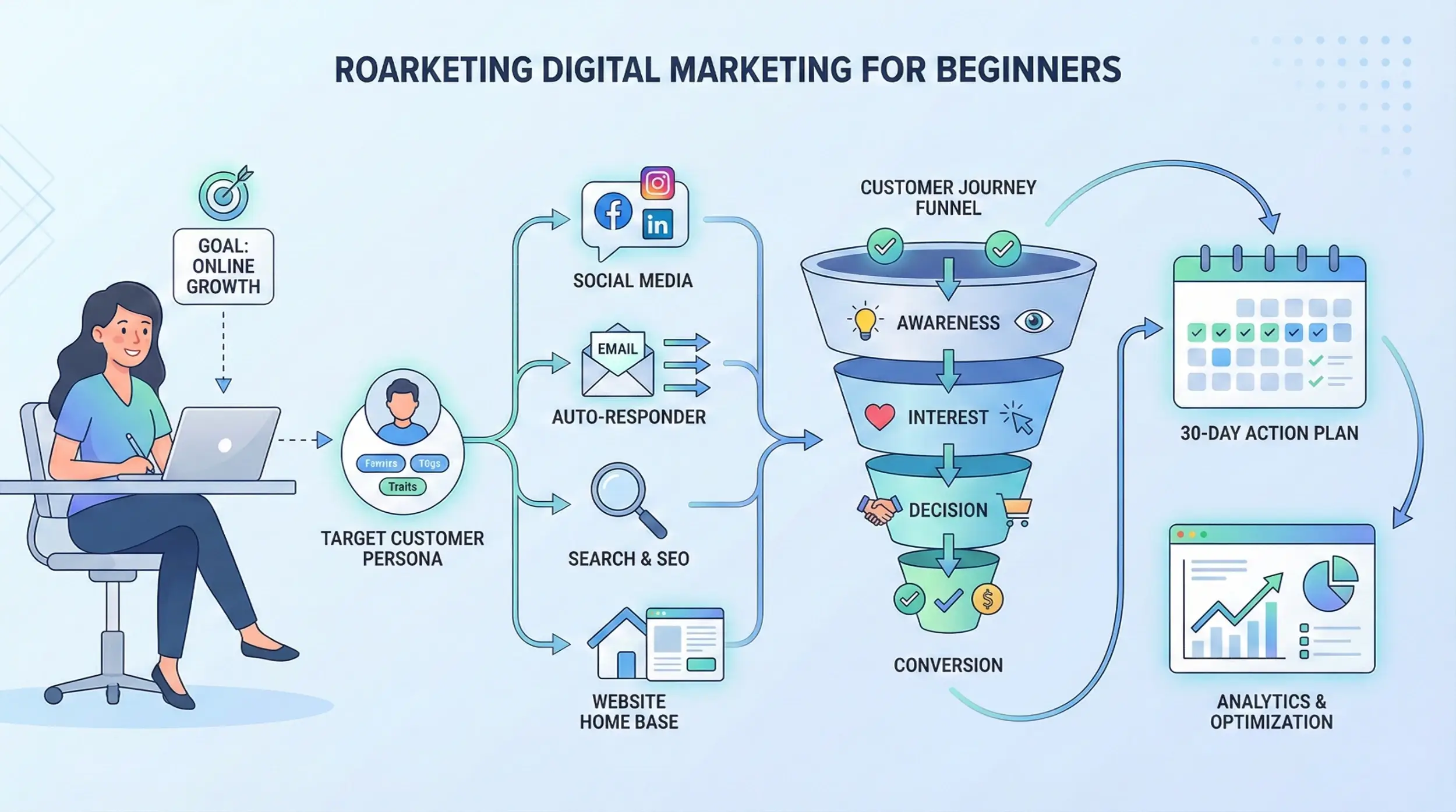
In this guide, you’ll walk away with: one measurable goal, a simple way to define your audience, a smart channel setup, a basic customer journey (from first touch to repeat), and a realistic 30-day starter plan, plus what to track each week so you know what to fix next.
Step 1: Start with one clear goal and one clear customer
Beginners fail for a simple reason: they try to market to everyone and aim for too many outcomes at once. One week it’s “brand awareness,” the next week it’s “sales,” then it’s “followers,” and the message changes every time. People can’t buy what they can’t quickly understand.
Think of your marketing like a road trip. If you keep switching destinations, you’ll spend the whole day driving and never arrive.
This step is about focus. Whether you run a local service business, an online shop, or you’re a creator, you’ll get faster results by picking one main goal and one clear customer type.
Pick a goal you can measure (and tie it to your business)
Choose a goal that connects to revenue, even if it’s one step away from a sale. Good beginner-friendly goals include getting leads, booking calls, selling a starter product, or growing an email list.
Make it measurable by adding a number and a time frame. For example: “Get 20 quote requests in the next 30 days,” “Book 10 intro calls this month,” or “Add 100 email subscribers in 4 weeks.” You can start small. A goal that’s hit builds momentum.
Avoid vanity metrics when you’re starting. Likes and views can feel great, but they don’t pay rent unless they lead to clicks, signups, calls, or sales. If you track anything early, track actions that show intent, like form fills, email signups, and bookings.
Define your audience in one paragraph (pain, desire, and what they search)
If you’re speaking to “small businesses” or “anyone who wants to get fit,” you’re going to sound generic. Instead, write a one-sentence audience statement you can actually use in ads, posts, and your website.
Use this fill-in-the-blank template:
I help [who] who struggle with [problem] so they can [result].
Examples:
- Local service: “I help busy homeowners who need their yards cleaned up so they can enjoy a tidy outdoor space again.”
- Online shop: “I help new campers who don’t know what gear to buy so they can pack light and stay comfortable.”
- Creator: “I help first-time freelance designers who hate sales calls so they can book projects through a simple portfolio site.”
To find the wording real customers use, skim your emails and DMs, read reviews (yours and competitors), check Reddit threads, use Google autocomplete, and scan competitor FAQ pages. Then add one point of difference, like faster turnaround, a clear niche, budget-friendly options, or a calmer service style.
Step 2: Choose your channels and map the customer journey
A solid digital marketing strategy for beginners doesn’t mean being everywhere. It means showing up in the right place, with the right message, at the right time.
Start by picking 1 to 2 channels, then match them to how people buy. If your offer is expensive or personal (like coaching or home services), trust matters more. If your product is low-cost and simple, speed and convenience matter more.
Your customer journey can stay simple: people discover you, they learn to trust you, they act, then some come back and buy again.
Use the “core three” setup: a home base, a traffic source, and a follow-up channel
This setup keeps your marketing stable, even if a platform changes its rules.
- Home base: a landing page, a basic website, or a simple storefront where the offer is clear.
- Traffic source: how people find you (SEO, social content, paid ads, partnerships, or local listings).
- Follow-up channel: how you stay in touch (email list, SMS, or retargeting ads).
A few beginner-friendly combos:
- SEO + landing page + email list (great for steady leads over time)
- Instagram + landing page + email list (good for service providers and creators)
- YouTube + landing page + email list (strong for trust and higher-priced offers)
The point is control. Social platforms are rented space. Your home base and email list are closer to owned space.
Create a basic funnel: what people need to see before they buy
People rarely buy the first time they hear about you. They need a few “yes” moments in a row. Keep it simple and build content for each stage:
- Discover: short tips, search-friendly posts, local service pages, or quick videos that solve one small problem.
- Trust: testimonials, before-and-after examples, case studies, comparisons (“A vs. B”), and clear FAQs.
- Act: an offer page, a booking link, a product page, or a limited bonus (like free setup or a starter discount).
- Repeat: an onboarding email, a “how to use this” guide, a check-in message, and a referral ask.
Two quick rules: make your pages mobile-friendly, and use one clear call to action per page (book, buy, or subscribe). If your page has three different buttons, most people click none.
Step 3: Build a 30-day plan, then track and improve each week
A plan beats motivation. You don’t need to post daily or spend big money. You need consistent reps and a short feedback loop.
Think of the first 30 days as a test kitchen. You’re not chasing perfection, you’re learning what people respond to, what they ignore, and what makes them take the next step.
A beginner 30-day digital marketing plan you can follow
Here’s a simple month you can finish, even with a full-time job:
- Week 1, set up the basics: clarify your offer, publish one landing page, add one lead magnet (like a checklist) or a simple first-time discount, install analytics, and write a short welcome email.
- Week 2, publish helpful content: create 2 to 3 pieces that answer common questions, plus one FAQ page or post. If you’re on social, write one repeatable script you can reuse with new examples.
- Week 3, drive traffic on purpose: improve one SEO page (title, headings, and clarity), join 2 communities where your buyers hang out, and send one partnership message (a local business, newsletter, or creator with a similar audience).
- Week 4, improve conversion: add 2 to 3 testimonials, tighten your call to action, send 2 emails (one helpful, one with a direct offer), and run a small paid test only if you can afford to lose that money.
If you miss a day, don’t reset the plan. Just pick up the next task.
Track the few numbers that tell you what to fix next
You don’t need a dashboard that looks like a cockpit. You need a small scorecard and a 15-minute weekly review.
| Metric | What it tells you | If it’s low, try this next |
|---|---|---|
| Visits (traffic) | Are people finding you? | Publish more search-based content, post consistently, or get a partner shoutout |
| Conversion rate | Does your page make sense? | Simplify the page, clarify the offer, add proof, reduce form fields |
| Email signups | Is your lead magnet useful? | Make the free offer more specific, improve the headline, add it higher on the page |
| Reply or booking rate | Are leads serious, and is follow-up working? | Shorten response time, add a clear next step, tighten your email sequence |
| Cost per lead (if using ads) | Are ads efficient enough? | Improve targeting, test a new headline, or send clicks to a clearer page |
| Sales | Is the full path working? | Improve the offer, add trust content, and follow up more consistently |
For privacy-friendly tracking, focus on first-party data you control, like email signups and bookings. Use UTM links (simple tags added to your URLs) so you can tell which post, email, or ad brought the click.
Conclusion
A beginner-friendly digital marketing strategy comes down to three moves: pick one measurable goal, define one clear customer, then choose a simple channel setup that guides people from discover to trust to action. After that, run a 30-day plan, track a few numbers, and make one improvement each week. That’s how you build results that stack up over time.
Your next step is simple: write your one-sentence audience statement, choose a single goal for the next 30 days, and plan Week 1 on your calendar. Start small, then stay consistent.