
Table of Contents
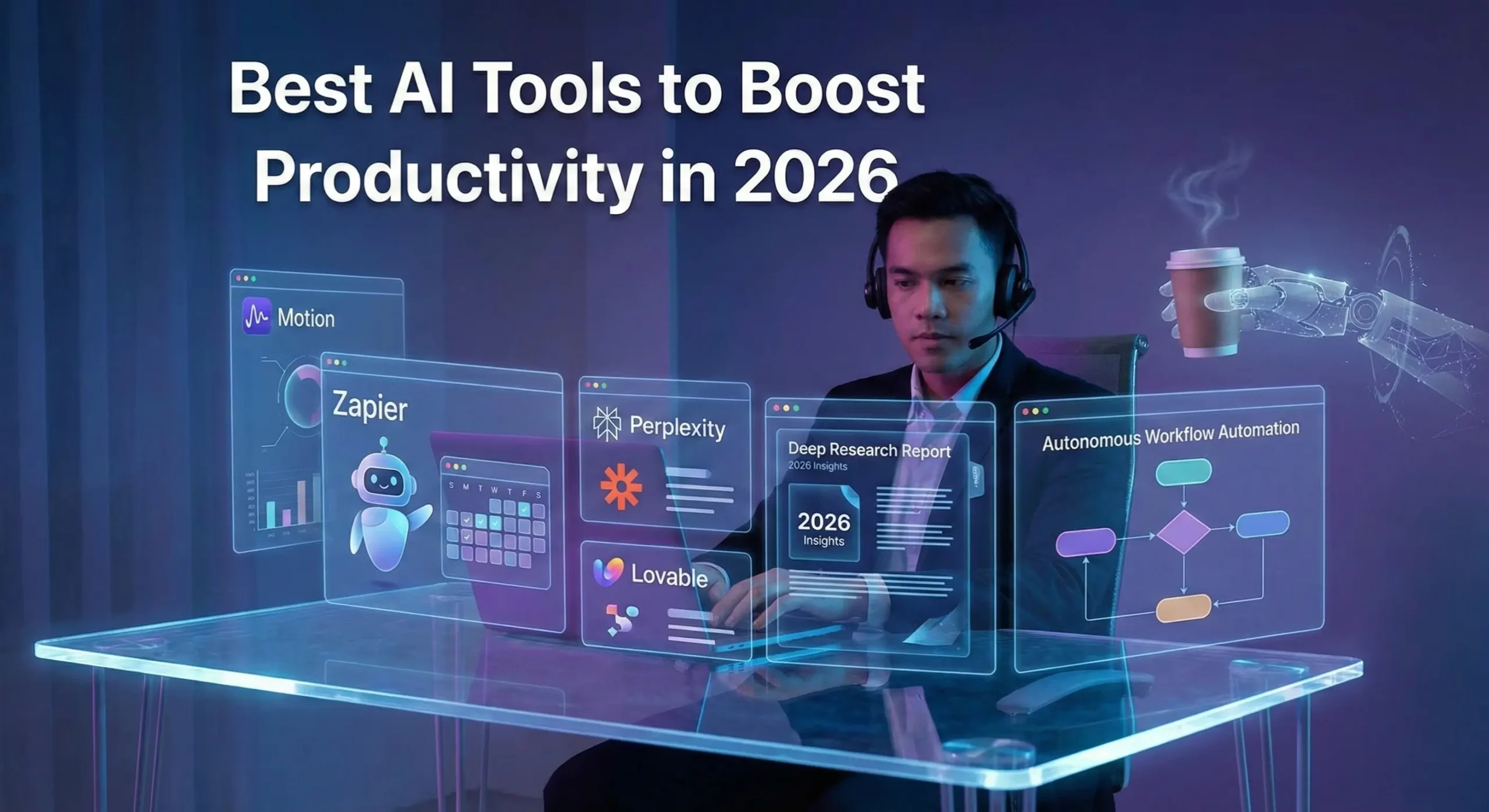
The productivity landscape has shifted dramatically over the last few years. We have moved past the era of simple chatbots that answer questions into a world of autonomous agents that actually do the work for us. In 2026, being productive is no longer about how many tasks you can check off a list; it is about how effectively you can orchestrate your AI ecosystem.
Whether you are a solo entrepreneur, a creative professional, or a corporate leader, the tools you use today determine your capacity for tomorrow. If you still find yourself manually scheduling meetings or spending hours summarising research papers, you are likely working harder than necessary. This guide breaks down the most essential AI tools currently redefining efficiency.
The Rise of Agentic AI: Beyond Chatbots
In 2026, the buzzword is agency. We are no longer satisfied with an AI that just writes an email draft. We want an AI that knows our calendar, understands our priorities, and sends that email at the optimal time without being prompted. This shift toward agentic AI is the biggest productivity jump we have seen since the invention of the spreadsheet.
These tools act as digital employees rather than just software. They can navigate web interfaces, book travel, manage complex project timelines, and even negotiate basic contracts. The goal is to move from manual execution to high-level supervision.
OpenAI Operator and Autonomous Execution
OpenAI Operator has become a cornerstone for professionals who need multi-step tasks handled autonomously. Unlike traditional assistants, Operator can be given a goal—such as booking a multi-city business trip within a specific budget—and it will handle the research, comparison, and booking across various websites.
- Autonomously navigates browser-based software.
- Handles complex, multi-stage logistics.
- Reduces manual data entry across fragmented platforms.
Motion: The Self-Optimizing Calendar
If you still use a static calendar, you are living in the past. Motion has evolved into a sophisticated AI manager that treats your time as a finite resource. It does not just hold appointments; it actively reschedules your day when a meeting runs long, or a high-priority task arrives.
Motion uses predictive algorithms to ensure that deep work is prioritised. It identifies your most productive hours and automatically blocks them off, moving administrative tasks to your low-energy periods. It is like having a Chief of Staff who never sleeps and has no ego about moving your 3:00 PM call to Tuesday.
Deep Research and Knowledge Retrieval
One of the greatest productivity drains is the search for information. In the past, we spent hours sifting through search engine results and academic PDFs. In 2026, the best AI tools to boost productivity focus on synthesising vast amounts of data into actionable insights in seconds.
The ability to accurately retrieve and verify information is now a baseline requirement for any serious professional. Tools in this category have moved away from hallucinations toward strict, source-backed reporting.
Perplexity: The Death of the Search Engine
Perplexity has effectively replaced traditional search for many power users. Instead of a list of blue links, it provides a comprehensive, cited report on any topic. In 2026, its Deep Research feature allows users to perform hours of market analysis in under three minutes.
- Provides real-time citations for every claim.
- Executes multi-step searches to cross-reference data.
- Generates professional-grade reports with structured formatting.
NotebookLM: Your Personal Knowledge Base
Google’s NotebookLM has become the gold standard for anyone dealing with heavy documentation. By uploading your own library of PDFs, transcripts, and notes, you create a private AI that only knows your data. This is particularly useful for lawyers, researchers, and project managers who need to find a specific needle in a haystack of documents.
The tool’s ability to generate “Audio Overviews”—essentially a podcast where two AI voices discuss your data—has become a favourite for busy professionals who prefer to consume their research while commuting.
Advanced Workflow Automation
True productivity comes from removing the friction between different apps. If you are still copying data from a Slack message into a Trello board and then into a monthly report, you are losing hours every week to “work about work.” The latest automation tools require almost no technical knowledge to set up.
Modern automation is no longer about simple “if this, then that” rules. It is about “intent-based” workflows that adapt to the context of the information being processed.
Zapier Agents
Zapier has moved beyond simple triggers into full-scale AI agents. You can now build an agent that monitors your leads, researches their company on LinkedIn, drafts a personalised pitch, and notifies you only when the lead is “warm.” This level of automation turns a manual sales process into a self-running machine.
n8n: The Power User’s Choice
For those who want more control over their data and logic, n8n offers a flexible, often self-hosted alternative to mainstream automation. It is particularly valued in 2026 for its ability to handle complex branch logic and its “fair-code” model, which appeals to privacy-conscious enterprises.
Recent developments in AI research and development have allowed tools like n8n to integrate directly with local LLMs, ensuring that sensitive company data never leaves the internal network while still benefiting from advanced AI reasoning.
Coding and Technical Creation for Non-Developers
The barrier between an “idea” and a “product” has never been thinner. In 2026, the best AI tools to boost productivity include platforms that allow non-technical professionals to build their own internal tools, dashboards, and applications using natural language.
This democratisation of development means that departments no longer have to wait for the IT backlog to clear. They can build the solutions they need in an afternoon.
Lovable: Full-Stack Apps from Text
Lovable has taken the world by storm by allowing users to describe a web application and seeing it come to life in real-time. It handles the frontend, the backend, and the database architecture. For a manager who needs a custom inventory tracker or a unique client portal, this tool saves weeks of development time and thousands of dollars.
GitHub Copilot and Cursor
For those who do code, GitHub Copilot and Cursor have become indispensable. They are no longer just autocomplete tools; they are pair programmers. They can refactor entire codebases, suggest architectural changes, and even write comprehensive test suites based on a single comment. This has effectively doubled the output of engineering teams worldwide.
Common Mistakes When Adopting AI Tools
Despite the power of these tools, many professionals fail to see a real boost in productivity. This usually stems from a few common pitfalls that are easy to avoid if you are intentional about your setup.
- Tool Overload: Buying every new AI subscription leads to “context switching” fatigue. It is better to have three well-integrated tools than twelve disconnected ones.
- Lack of Verification: While AI has improved, it is not infallible. Relying blindly on an AI-generated legal summary or financial forecast without a quick human check is a recipe for disaster.
- Ignoring Data Privacy: Many beginners feed sensitive client data into public AI models. Always ensure your tools have enterprise-grade privacy settings or “zero-retention” policies.
- Treating AI as a Search Engine: AI is a reasoning engine, not a database. If you use it just to find facts, you are missing 90% of its value in synthesis and planning.
Best Practices for a Productive 2026
To truly maximise your output, you need a strategy. Productivity in the age of AI is a skill that requires constant refinement. Here is a checklist to ensure you stay ahead of the curve.
- Audit Your Weekly Tasks: Spend one week tracking every repetitive task you do. If a task takes more than 10 minutes and happens more than twice a week, there is an AI tool that can handle it.
- Centralise Your Context: Use tools like Notion AI or Mem to keep all your project notes in one place. AI performs best when it has a single, deep source of truth to pull from.
- Master Prompt Engineering: Learn the difference between a vague request and a structured prompt. Providing “Persona, Context, Task, and Constraints” will consistently yield better results.
- Implement a “Human-in-the-Loop” System: Set up your automations so that the AI does 95% of the work but requires a final “approve” click from you before anything is published or sent to a client.
Final Thoughts
The best AI tools to boost productivity in 2026 are those that disappear into your workflow. They shouldn’t feel like another app to manage; they should feel like an extension of your own capabilities. We are moving toward a future where the most successful professionals are not those who work the longest hours, but those who build the smartest systems.
Start small. Pick one area—whether it is your calendar, your research, or your email—and automate it completely. Once you feel the relief of having that cognitive load lifted, you can begin to scale your AI ecosystem. The technology is here; the only remaining variable is how effectively you choose to use it.