Table of Contents
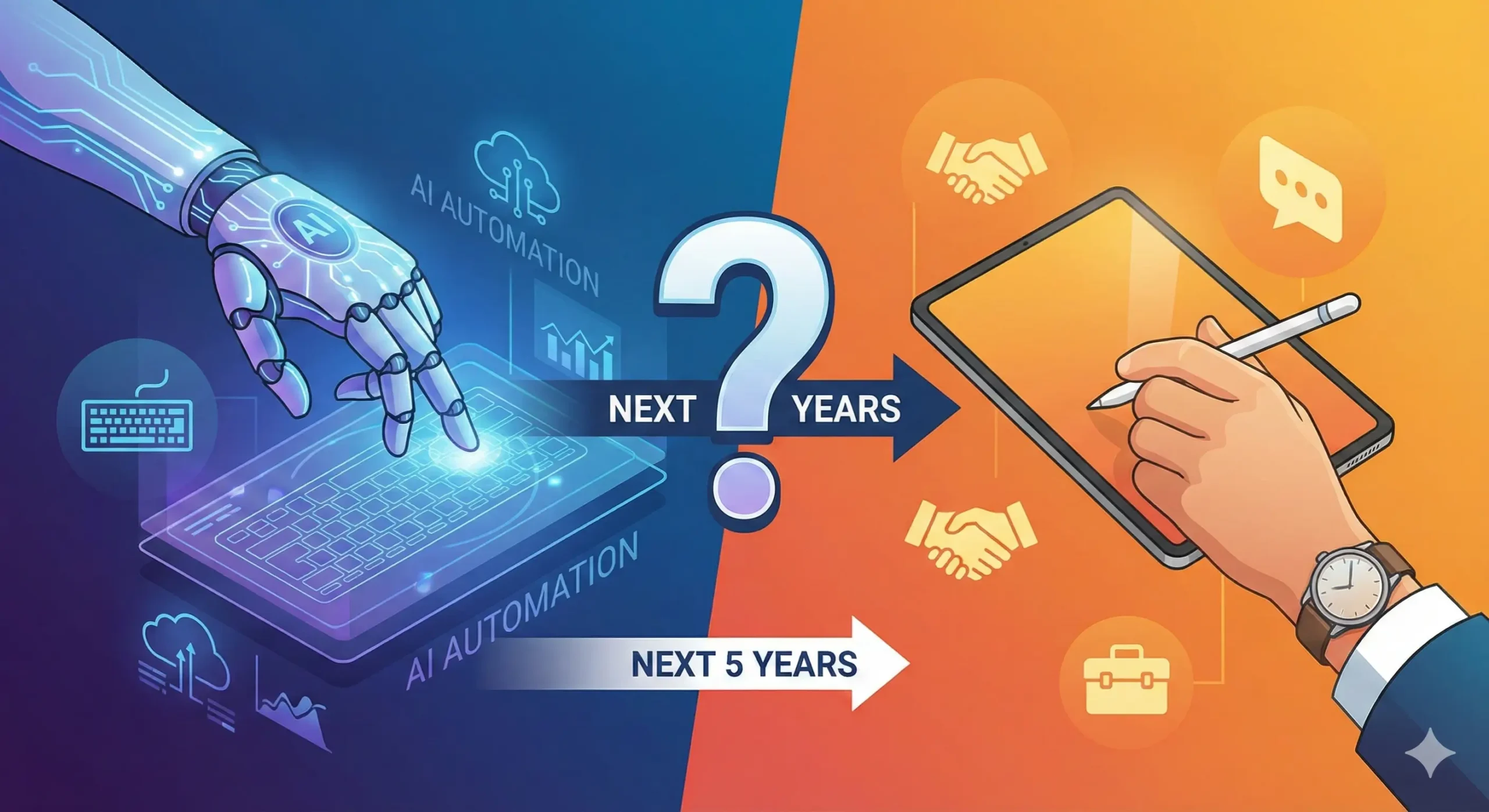
The conversation surrounding artificial intelligence has shifted from science fiction to a daily reality for millions of workers. As we navigate 2026, the question is no longer if AI will change the workforce, but which specific roles will bear the brunt of this transition over the next five years. The debate of AI vs humans is often framed as a battle, yet the reality is more about the evolution of tasks. By 2031, many traditional job descriptions will be unrecognisable, replaced by a combination of automated systems and highly specialised human oversight.
Understanding which jobs are at risk requires looking past the headlines and examining the nature of the work itself. If a job involves repetitive digital tasks, predictable data processing, or basic pattern recognition, it is likely on the frontline of automation. Conversely, roles that require deep empathy, physical dexterity in unpredictable environments, or high-stakes accountability remain firmly in human hands. This article explores the changing landscape of employment and provides a roadmap for staying relevant in an increasingly automated economy.
The Reality of AI Displacement in 2026
In 2026, we are witnessing the first major wave of job displacement caused by generative AI and advanced robotics. Unlike previous industrial revolutions that primarily affected manual labor, this wave is hitting cognitive and white-collar roles with surprising speed. Large language models and specialized AI agents can now handle complex scheduling, draft legal documents, and even write functional code at a fraction of the cost of a human employee.
Recent data suggests that up to 40 percent of work activities across the global economy could be automated using technology that exists right now. This does not mean 40 percent of people will be unemployed, but it does mean their roles will be radically redesigned. The displacement is most visible in industries where “information” is the primary product. As AI becomes more efficient at sorting, summarizing, and generating information, the value of the human “middleman” in these processes is rapidly declining.
White-Collar Roles Facing the Most Pressure
White-collar professionals once felt safe from the threat of automation, believing that their education and cognitive skills provided a permanent shield. However, the rise of sophisticated algorithms has proven that many desk jobs are actually composed of highly predictable tasks.
Data Entry and Administrative Support
Administrative assistants and data entry clerks are facing significant challenges. AI-powered tools can now manage calendars, transcribe meetings with near-perfect accuracy, and organize databases without human intervention. In the next five years, the demand for traditional administrative roles is expected to drop as companies adopt “autonomous agents” that act as 24/7 executive assistants. The few roles that remain will likely shift toward office management and high-level project coordination.
Junior Financial Analysts and Bookkeepers
The financial sector has embraced AI for its ability to process numbers without fatigue. Junior-level analysts who spend their days reconciling spreadsheets and creating standard financial reports are at high risk. Modern software can now perform audit checks and financial forecasting in seconds. By 2030, entry-level accounting will likely move away from “doing the math” and toward “verifying the machine’s math” and providing strategic advice based on those numbers.
Entry-Level Copywriters and Content Creators
The world of marketing has changed forever. Basic copywriting, such as product descriptions, social media posts, and simple news reports, is now largely handled by AI. While high-level brand strategy still requires a human touch, the “grub work” of content creation has been automated. Writers who do not learn to use AI as a tool for research and drafting may find it difficult to compete with the speed and volume of machine-generated content.
Industries Undergoing Massive Transformation
Beyond the office, several key industries are being reshaped by the integration of AI and physical robotics. These shifts are driven by the need for efficiency and the rising cost of human labor in logistics and retail.
The Retail and Customer Service Shift
If you have walked into a major department store lately, you have likely noticed the lack of traditional cashiers. Self-checkout was just the beginning. In the next five years, AI-driven retail environments will use computer vision to track purchases, eliminating the need for a checkout process entirely. Similarly, customer service is being dominated by voice-recognition AI that can handle 80 percent of routine inquiries without ever involving a human agent.
Logistics and Warehouse Operations
Warehousing has become a playground for AI innovation. Autonomous mobile robots now navigate massive fulfillment centers, picking and packing orders with robotic precision. While humans are still needed for “last-mile” delivery and complex troubleshooting, the bulk of warehouse labor is being replaced by automated systems that can work through the night without breaks or benefits.
The Human Edge: Jobs That Are Not At Risk
Despite the rapid advancement of technology, there are several categories of work that AI fundamentally cannot perform. These “future-proof” roles often center on what makes us uniquely human.
Skilled Trades and Physical Services
AI is excellent at digital logic, but it struggles with the physical world. An AI cannot crawl under a sink to fix a burst pipe or navigate the unique wiring of a century-old house. Electricians, plumbers, and HVAC technicians are in higher demand than ever. These roles require a combination of physical dexterity, spatial reasoning, and real-time problem-solving in unpredictable environments—tasks that current robotics cannot replicate at scale.
High-Level Strategy and Leadership
While AI can provide data-driven insights, it cannot make the final decision on a company’s mission or take responsibility for a moral failure. Leadership is about trust, vision, and the ability to inspire a team. Investors and employees still want a human at the helm who can navigate the nuances of company culture and ethical dilemmas. Roles like CEOs, creative directors, and senior project managers remain secure because they involve high-stakes accountability.
Healthcare and Emotional Intelligence Roles
Medicine is becoming more digital, but the “care” in healthcare remains human. While an AI might be better at spotting a tumor on an X-ray, it cannot sit with a patient and explain a difficult diagnosis with empathy. Nurses, therapists, and social workers are protected by the “emotional intelligence” gap. Humans have a biological need for connection, and automated systems simply cannot provide the comfort or understanding required in mental health and end-of-life care.
Common Mistakes When Thinking About AI and Jobs
One of the biggest mistakes people make is assuming that AI will replace “jobs” rather than “tasks.” A job is a collection of tasks. If 20 percent of your tasks are automated, you have 20 percent more time to focus on higher-value work. Many people fail to realize that the goal is not to beat the machine, but to use the machine to be better at their job.
Another common pitfall is the belief that a university degree is a permanent shield against automation. In 2026, we are seeing that some vocational trades are more “AI-proof” than many bachelor’s degrees in business or communications. The mistake is valuing “knowledge” over “application.” In a world where AI has access to all the knowledge, the ability to apply that knowledge in complex, real-world situations is the true currency.
How to Stay Relevant: Actionable Tips for the Next 5 Years
To survive and thrive in the next five years, you must pivot your mindset from being a “worker” to being an “orchestrator.” Here are a few ways to ensure your career remains stable.
First, focus on AI literacy. You do not need to be a computer scientist, but you do need to know how to talk to the machines. Learning prompt engineering and understanding how to audit AI-generated work will be essential skills for every office professional.
Second, double down on human skills. Communication, negotiation, and empathy are the “soft skills” that have become “hard assets.” If your job involves a lot of human interaction and conflict resolution, you are in a strong position.
Third, look for internal linking opportunities to stay updated on the latest trends, such as the future of remote work and the impact of automation on productivity. Continuous learning is the only way to keep pace with the 2026 job market. Consider specializing in areas like ethics or AI auditing, as companies will need people to ensure their algorithms are fair and compliant with new regulations.
Final Thoughts: Embracing a Hybrid Future
The “AI vs Humans” debate is reaching a conclusion, and the result is not a total replacement but a total redesign. The next five years will be a period of intense transition. Some roles will vanish, but new ones—like AI trainers, data ethicists, and human-machine interface designers—will emerge to take their place.
The key takeaway is that the most successful workers of 2031 will not be those who tried to ignore AI, but those who learned to work alongside it. By focusing on complex problem-solving and emotional intelligence, you can build a career that technology only enhances, rather than replaces. The future of work is hybrid, and the best time to prepare for it is today.