
Table of Contents
The transition from traditional video production to the era of generative AI has happened with the subtle grace of a freight train. Just a few short years ago, creating a professional brand video required a crew, a studio, and a budget that could rival a small island’s GDP. Today, the landscape is entirely different. We are no longer asking if artificial intelligence can make a video; we are asking which specific algorithm has the best “creative eye” for our corporate identity.
In the current market of 2026, the term “AI Video Tools Decoded” isn’t just a catchy headline; it is a necessary survival manual for marketing departments and internal communications teams. With the release of heavy hitters like Google Veo 3.2 and OpenAI’s Sora 2, the barrier to entry for high-fidelity cinema has collapsed. However, this democratisation of video has brought with it a new problem: choice paralysis. Every tool claims to be the best, yet each serves a vastly different master.
If you are a business leader trying to figure out where to park your subscription dollars, you are likely looking for more than just “cool” pixels. You need stability, brand consistency, and a workflow that doesn’t require a PhD in prompt engineering. This guide is designed to cut through the marketing fluff and help you identify which tool will actually move the needle for your specific business goals.
The State of AI Video in 2026: A New Hierarchy
To understand the current market, we have to look at the specialised niches that have formed. We have moved past the “one size fits all” phase of AI development. Today, the leading tools have staked their claims in specific territories: cinematic realism, social media agility, and corporate avatar representation. Choosing the wrong one is like bringing a sports car to a construction site—it is impressive, but it won’t get the job done.
The Realism Kings: Google Veo and Sora 2
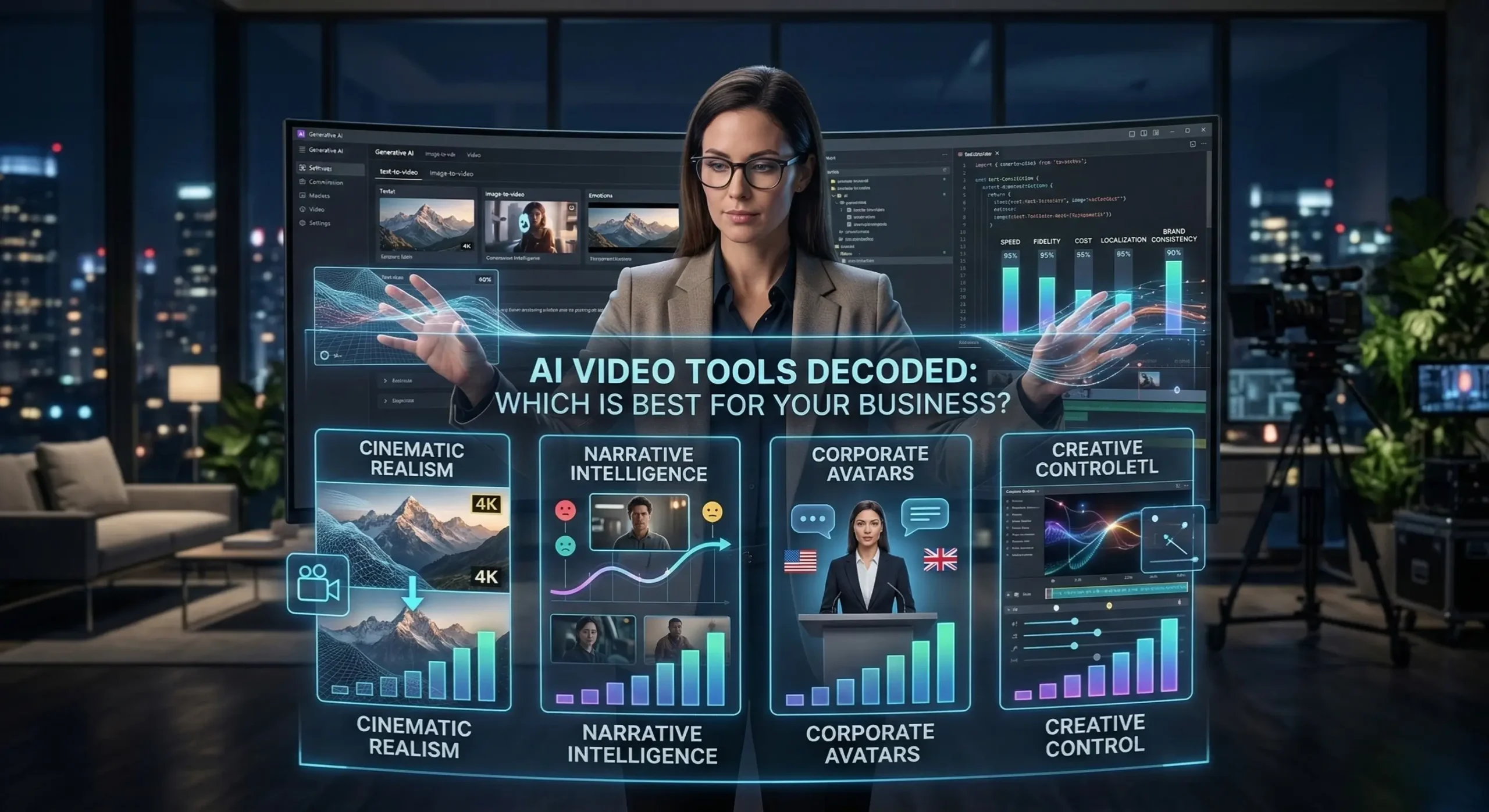
For those in need of high-end commercial visuals or atmospheric B-roll, the battle is currently between Google and OpenAI. Google Veo 3.2 has positioned itself as the “cinematographer’s AI.” It excels at physical accuracy—meaning when it renders water splashing or fabric moving, it adheres to the laws of physics with startling precision. It is the tool you use when your brand cannot afford the “uncanny valley” look.
On the other side, Sora 2 remains the champion of narrative intelligence. While it might occasionally struggle with complex physical simulations, it understands character emotion and story arc better than almost any other model. If your business needs to tell a story that pulls at the heartstrings, Sora 2 is your lead actor. Both models now support native 4K resolution, which has finally made AI-generated content viable for large-screen presentations and traditional television advertising.
The Avatar Specialists: Synthesia and HeyGen
Not every business needs a cinematic masterpiece. Many need a way to scale internal training, localised sales pitches, and onboarding videos without booking a spokesperson every time a script changes. This is where AI avatars shine. Platforms like Synthesia have evolved to the point where “lip-sync” issues are largely a thing of the past. Their library of over 140 professional avatars allows a global company to produce a training video in London and have it translated into 120 languages with localised accents by lunchtime.
The Core Benefits for Small and Medium Enterprises
While the tech giants are fighting over who has the best lighting engine, small and medium enterprises (SMEs) are reaping the practical rewards. The “AI Video Tools Decoded” conversation for an SME isn’t about artistic purity; it’s about the bottom line. The ability to iterate at the speed of thought has changed the competitive landscape.
- Unprecedented Speed to Market: In the past, a pivot in your marketing strategy meant weeks of re-shooting. Now, a change in copy can be reflected in your video assets in under ten minutes.
- Cost Reduction: By eliminating the need for expensive stock footage subscriptions or recurring production fees, businesses can redirect those funds into ad spend or product development.
- Global Localisation: Small businesses can now appear as global players. With AI voice cloning and translation, your boutique shop in Ohio can have a professional video presence in Tokyo or Berlin with zero extra effort.
Improving Internal Communications
One of the most transformative uses of these tools is hidden away in HR and operations. Lengthy manuals and dry emails are being replaced by short, engaging AI-generated video clips. When an employee can watch a 60-second summary of a new policy presented by a lifelike avatar, retention rates skyrocket. It turns information into an experience, making the workplace feel more modern and connected.
Common Mistakes When Integrating AI Video
Because the technology feels like magic, it is very easy to cast the wrong spell. Many businesses dive into AI video with high hopes only to end up with content that feels hollow or, worse, damaging to their brand reputation. Here is why people often get it wrong.
The “Set It and Forget It” Fallacy
AI is a tool, not a replacement for a creative director. One of the biggest mistakes is accepting the first output the AI generates. While the visuals might be impressive, they often lack the subtle brand cues that make your company unique. Without human oversight, AI content can feel “generic” and fail to build a genuine connection with your audience. You must treat the AI as a very fast intern who still needs their work checked by a senior editor.
Ignoring the Ethical and Legal Landscape
As we move deeper into 2026, the regulatory environment is tightening. Using AI video without proper disclosure can lead to trust issues with your customers. Furthermore, if you are using tools that were not trained on ethically sourced data, you could be opening your business up to future copyright claims. According to guidelines often discussed by the Consumer Financial Protection Bureau regarding transparency and consumer trust, being honest about the use of synthetic media is becoming a standard expectation for professional organisations.
Overcomplicating the Prompts
Beginners often try to write three-page descriptions for a five-second clip. Modern tools like Kling AI and Runway Gen-4.5 have become highly intuitive. Over-prompting can actually confuse the model, leading to “visual artefacts” or logical inconsistencies. The best practice is to be clear, concise, and focused on the mood and lighting rather than trying to micromanage every pixel.
Best Practices for Your AI Video Strategy
If you are ready to implement these tools, you need a roadmap that prioritises quality over novelty. Use this checklist to ensure your first foray into AI video is a success.
- Define Your Use Case First: Do not buy a subscription because a tool is “viral.” Decide if you need B-roll (Veo/Sora), Avatars (Synthesia/HeyGen), or creative editing (Adobe Firefly).
- Maintain Subject Consistency: Use tools that allow for character locking. If your brand “mascot” looks different in every frame, your audience will lose focus. Google’s Nano Banana 2 integration in their Flow tool is particularly good at this.
- Prioritise Audio: A visually stunning video with “robotic” or poorly synced audio will fail. Choose platforms that offer integrated, high-fidelity soundscapes and realistic voiceovers.
- Start with Hybrid Content: You don’t have to go 100 per cent AI. Use AI to generate specific backgrounds or B-roll while keeping your human lead on camera. This maintains the “human touch” while slashing production costs.
- Establish a Disclosure Policy: Be a leader in your industry by clearly stating when video content is AI-augmented. This builds long-term authority and trust with your audience.
The Technical Breakdown: Comparing the Top Contenders
To make your decision easier, let’s look at a side-by-side comparison of the heavy hitters in the 2026 market. Each has a “personality” that suits different business needs.
Google Veo 3.2
This is the “Industrial Grade” choice. It is heavily integrated into the Google Workspace, making it ideal for teams already using Gemini and Flow. It offers 4K resolution and the most realistic physics in the industry. It is best for product demonstrations and high-end marketing where accuracy is non-negotiable.
OpenAI Sora 2
The “Storyteller.” Sora 2 is unmatched in its ability to follow complex narrative instructions. It is the best choice for cinematic social media ads and concept trailers. However, access can be more expensive and generation times are often slower than the competition.
Synthesia
The “Corporate Workhorse.” If your goal is to replace a hundred PowerPoint slides with five minutes of engaging video, this is your tool. It is reliable, consistent, and provides the best management tools for large teams.
Runway Gen-4.5
The “Artist’s Palette.” Runway offers more granular control than almost any other tool. With features like the multi-motion brush and precise camera controls, it is the favourite of creative agencies that want to tweak every aspect of the final shot.
Final Thoughts: Embracing the Future of Communication
Navigating the world of “AI Video Tools Decoded” is no longer an optional exercise for the tech-savvy; it is a fundamental requirement for the modern business leader. The transition to generative video represents the biggest shift in communication since the invention of the internet itself. It is a moment of profound opportunity for those willing to learn the ropes and a significant risk for those who remain on the sidelines.
The key to success is not in finding the most “powerful” tool, but in finding the one that aligns with your brand’s voice and your team’s workflow. Start small, iterate often, and never lose sight of the fact that technology is there to serve the human connection, not replace it. As you integrate these tools, focus on the value you are providing to your audience. When the “magic” of AI is used to deliver a clearer message or a more helpful tutorial, everyone wins.