Table of Contents
The entrepreneurial landscape of 2026 is no longer about who works the hardest, but who works the smartest with the most integrated tools. We have moved past the era of simple automation into the age of agentic assistance and seamless hardware. For the modern founder, the right technology is no longer a luxury; it is the invisible infrastructure that prevents burnout and facilitates growth.
In a world where digital noise is at an all-time high, the focus has shifted toward “Calm Tech”—devices that provide maximum utility with minimum distraction. Whether you are scaling a remote startup or managing a local venture, your toolkit needs to evolve to handle the speed of 2026 business cycles. If your current setup still feels like a collection of disconnected plastic boxes, it is time for an upgrade.
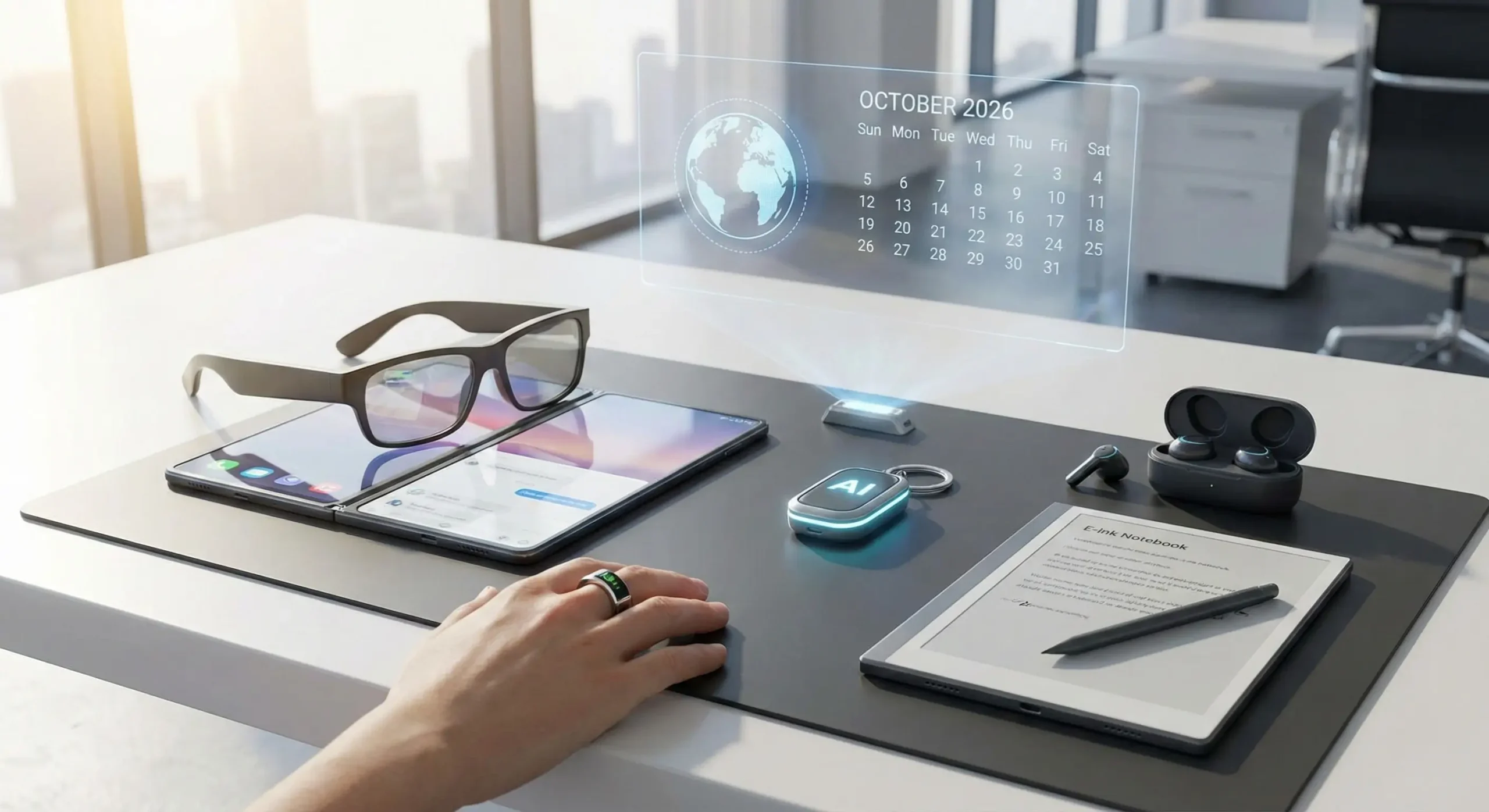
This curated list explores the essential tech gadgets for entrepreneurs that are defining the professional standard this year. These are not just shiny toys for early adopters; they are high-leverage investments designed to give you back the most precious commodity you have: your time.
1. Agentic AI Keychain Assistants
The most significant shift in 2026 is the move from reactive AI to proactive, agentic AI. Unlike the voice assistants of the past that waited for a command, these keychain-sized devices observe your workflow, learn your habits, and anticipate your needs. They act as a physical manifestation of your digital twin, bridging the gap between your intent and execution.
For an entrepreneur, this means a device that realises you are running five minutes late for a meeting and automatically sends a polite, personalised update to the participants. It listens to your verbal commitments during the day and populates your task manager without you ever touching a screen. It is essentially a chief of staff that fits in your pocket, minus the salary and the need for coffee breaks.
Practical Application for Founders
- Automated meeting rescheduling based on real-time traffic or previous task overruns.
- Instant summarisation of verbal conversations into actionable project boards.
- Voice-activated document retrieval that finds the exact PDF you mentioned three weeks ago.
2. Augmented Reality (AR) Business Glasses
The “space travel” look of early smart glasses is officially dead. The 2026 generation of AR glasses is indistinguishable from high-end designer frames. However, behind the lenses lies a powerful heads-up display that eliminates the need to constantly check your phone. For the entrepreneur who is always on the move, these are game-changers for maintaining presence while staying informed.
Imagine walking into a networking event and having the LinkedIn profiles of your key prospects subtly displayed in your peripheral vision. Or, consider the benefit of following a GPS map projected onto the sidewalk in front of you instead of looking down at a screen while walking through a new city for a pitch. These glasses allow you to keep your head up and your eyes on the opportunities in front of you.
Key Features for Professional Use
Modern AR glasses now feature “Privacy Tinting,” which ensures that your digital display is invisible to anyone looking at you. This allows for discreet data checking during high-stakes negotiations or board meetings without appearing distracted.
3. Biometric Smart Rings for Health and Security
Wrist-based trackers have their place, but the 2026 entrepreneur prefers the subtlety of the smart ring. These devices have evolved far beyond basic step counting. They now serve as your primary security key, replacing passwords, car keys, and office fobs with a simple encrypted proximity sensor. If you touch your laptop, it unlocks; if you walk away, it secures itself.
More importantly, these rings provide deep-tier health analytics. By tracking heart rate variability (HRV) and skin temperature, they can warn you of impending illness or high-stress spikes before you consciously feel them. In the high-pressure world of startups, knowing when to take a ten-minute break can be the difference between a breakthrough and a breakdown.
4. Self-Charging Kinetic Earbuds
There is a specific type of entrepreneurial frustration that occurs when your earbuds die halfway through a critical investor call. In 2026, that problem will have been solved by kinetic and solar-integrated charging. These earbuds capture micro-energy from your movement and ambient light, significantly extending their battery life indefinitely for most users.
Beyond the battery, the integrated AI now offers real-time “Focus Masking.” This isn’t just noise cancellation; it is an intelligent soundscape that identifies the frequency of distractions in your environment—like a hum in a coffee shop or a nearby conversation—and counters them with productivity-enhancing frequencies tailored to your brain’s current state.
Why Entrepreneurs Love Them
- Zero downtime during long travel days or back-to-back virtual summits.
- Instant real-time translation for international business negotiations.
- Voice-isolation technology that makes you sound like you’re in a studio, even on a windy street.
5. Next-Gen Foldable Workstations
The smartphone has finally completed its evolution into a legitimate workstation. The 2026 flagship foldable devices feature ultra-durable, crease-free displays that expand into a tablet-sized canvas perfect for editing spreadsheets or reviewing legal contracts. When paired with a foldable magnetic keyboard, the “laptop vs. phone” debate becomes irrelevant.
These devices are often powered by agentic AI architectures that allow the hardware to distribute processing power based on the intensity of your current task. They are designed for the entrepreneur who refuses to be tethered to a desk but requires the computing power to run complex simulations or data visualisations on the fly.
6. AI-Integrated High-Fidelity Voice Recorders
While phones can record audio, dedicated AI voice recorders have become a staple for founders who do their best thinking while walking or driving. These devices are optimised for “clean” audio capture and feature onboard processors that transcribe, tag, and organise your thoughts into your company’s internal knowledge base in real-time.
The magic happens in the post-processing. These gadgets don’t just give you a wall of text; they identify different speakers, highlight key decisions, and can even draft an initial project plan based on the verbal brainstorm you just had. It turns a ten-minute monologue into a structured executive summary instantly.
7. Smart E-Ink Notebooks
Despite the digital revolution, the tactile act of writing remains one of the best ways to process complex ideas. Minimalist entrepreneurs in 2026 have flocked to smart E-ink notebooks that offer the friction and feel of paper with the infinite organisation of the cloud. There is no blue light, no social media notifications, and no distractions—just you and your ideas.
These notebooks now feature “Live Sync,” where your handwritten notes are converted into searchable digital text and synced to your project management tools. If you draw a diagram during a meeting, it can be instantly converted into a polished graphic for your slide deck. It bridges the gap between the messy creativity of the human brain and the structured requirements of digital business.
8. Pocket Hologram Projectors
Pitching a physical product or a complex architectural design used to require bulky prototypes or 2D screen shares. In 2026, entrepreneurs carry pocket-sized hologram boxes. These devices project 3D, high-resolution visualisations onto any flat surface, allowing clients to “see” a product from every angle in real space.
This gadget is particularly effective for closing deals in informal settings like a lunch meeting. Being able to place a 3D model of your latest innovation on the table and rotate it with hand gestures creates a “wow factor” that a PowerPoint presentation simply cannot replicate. It makes your vision tangible and interactive.
Best Use Cases
- Real estate walkthroughs for prospective investors.
- Industrial design reviews with remote manufacturing teams.
- Interactive data visualisations for board presentations.
9. Wearable Stress-Management Patches
High-level entrepreneurship is an endurance sport. The newest frontier in 2026 tech is the biosensing skin patch. These discreet, paper-thin sensors monitor cortisol levels and hydration in real-time. Instead of waiting until you have a headache to realise you are dehydrated, the patch sends a gentle nudge to your ring or glasses.
By managing the physiological precursors to stress, entrepreneurs can maintain a “level head” during high-stakes situations. It turns the subjective feeling of “being stressed” into objective data that can be managed like any other business metric. If you want to optimise your output, you have to optimise your biology first.
10. Portable Hydrogen Power Banks
As our reliance on gadgets grows, the traditional lithium-ion power bank has hit its limit. The 2026 entrepreneur carries a compact hydrogen fuel-cell power bank. These devices are lighter, hold significantly more energy, and can be “recharged” instantly using small, recyclable hydrogen cartridges. No more waiting hours for a battery to charge from a wall outlet.
For the digital nomad or the founder who spends their life in airports and Uber backseats, this represents true energy independence. You can power a laptop, a tablet, and a phone for an entire week on a single cartridge. It is the ultimate insurance policy against the “low battery” anxiety that has plagued professionals for a decade.
Common Mistakes When Investing in Tech
Many entrepreneurs fall into the “Feature Creep” trap, where they buy gadgets based on impressive specs rather than actual workflow needs. Just because a device can do fifty things doesn’t mean it will help you do your one thing better. Over-complicating your tech stack can actually lead to a decrease in productivity as you spend more time managing the tools than doing the work.
Another common error is neglecting the “ecosystem fit.” In 2026, interoperability is king. If your smart ring doesn’t talk to your AI keychain, and your E-ink notebook won’t sync with your foldable workstation, you are creating digital silos. Before purchasing any new tech, ensure it has an open API or native integration with the software systems you already use to run your business.
The “Shiny Object” Syndrome
Entrepreneurs are naturally drawn to innovation, but 2026 tech is expensive. A common mistake is buying the first generation of a brand-new gadget category. Usually, waiting six months for the “version 1.1” firmware update saves both money and the frustration of dealing with early-adopter bugs.
Best Practices for Your 2026 Tech Stack
Building a high-performance gadget kit requires a strategic approach. Use this checklist to ensure your investments translate into a healthier bottom line:
- The 30-Day Audit: Before buying a new gadget, track how often you encountered the problem it claims to solve over the last month.
- Battery Uniformity: Aim for devices that use a standardised charging protocol (like USB-C 4.0 or wireless Qi2) to minimise the number of cables in your bag.
- Privacy First: In 2026, data is the most targeted asset. Only buy hardware from companies with a proven track record of on-device processing and end-to-end encryption.
- Ergonomic Focus: A gadget is only useful if it doesn’t cause physical strain. Test the weight of AR glasses and the fit of smart rings before committing.
- Automated Maintenance: Set your devices to auto-update during off-hours so you never walk into a meeting only to be greeted by a “System Updating” screen.
Final Thoughts
The tech gadgets for entrepreneurs in 2026 are designed to fade into the background, allowing your human creativity and strategic thinking to take centre stage. The goal of a modern tech stack is not to turn you into a robot, but to free you from the robotic tasks that consume your mental energy. By choosing tools that prioritise focus, health, and seamless integration, you aren’t just buying gadgets—you are buying the freedom to lead.
As you look toward the rest of the year, ask yourself which of these tools solves your biggest current bottleneck. Whether it is the cognitive load of a messy schedule or the physical fatigue of constant travel, there is a piece of 2026 technology ready to shoulder the burden. Start small, integrate deeply, and let the tech do the heavy lifting while you focus on building your legacy.