
Table of Contents
If your journey through the crypto world over the last few years felt like riding a unicycle through a thunderstorm, take heart. By early 2026, the storm has largely cleared, and the unicycle has been replaced by something much more resembling a professional-grade mountain bike. We are no longer in the era of “magic internet money” discussed in hushed tones at Thanksgiving; we are in the era of the regulated, institutionalized, and remarkably functional digital asset.
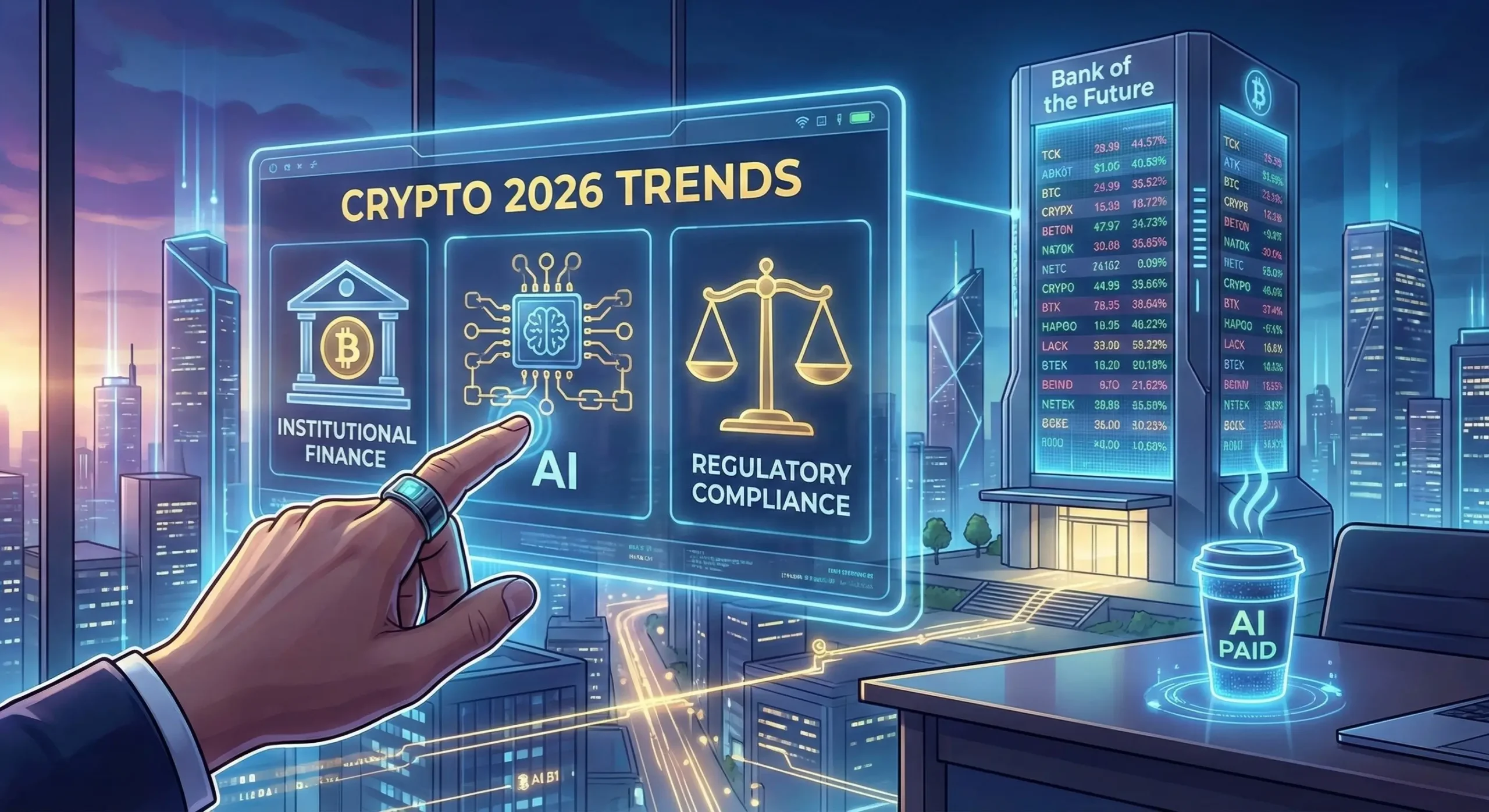
The future of cryptocurrency in 2026 is less about the dopamine hit of 100x gains on a meme coin and more about the quiet, systemic integration of blockchain into our daily lives. From your local bank offering Bitcoin custody to AI agents paying each other in stablecoins for cloud computing power, the landscape has matured. This guide breaks down exactly what you should watch as we navigate this high-tech, high-stakes year.
The Institutional “Grown-Up” Phase
For years, the industry begged for “the institutions” to arrive. In 2026, they haven’t just arrived; they have taken off their shoes and made themselves quite comfortable. The approval of various spot ETFs in 2024 and 2025 acted as a bridge, and now that bridge is a ten-lane highway. Major asset managers are no longer debating whether to own Bitcoin; they are debating how much of their portfolio should be “wallet-native.”
Bitcoin as the Strategic Reserve Asset
In 2026, Bitcoin has effectively completed its transition from a speculative tech play to “Digital Gold 2.0.” We are seeing more sovereign nations and corporate treasuries adding BTC to their balance sheets as a hedge against currency debasement. The four-year halving cycle, once the main driver of price, has been superseded by institutional flow dynamics. Large-scale buyers now move more capital than miners produce, leading to a market that is more stable, albeit slightly less “explosive” for the retail trader.
Ethereum and the Multi-Phase Roadmap
If Bitcoin is the gold, Ethereum has become the global settlement layer. We are currently witnessing the fruits of “The Surge” and “The Purge” phases. The focus has shifted from high gas fees on the main chain to a “rollup-centric” future where most transactions happen on Layer 2 networks. For the end user, this means transaction costs have plummeted to fractions of a cent, making decentralised applications (dApps) finally feel like regular websites. You can track the progress of these technical milestones on the official Ethereum Roadmap.
The Rise of the Machine Economy: AI Meets Crypto
Perhaps the most significant trend of 2026 is the convergence of Artificial Intelligence and blockchain. We have moved past the hype of “AI coins” and into the reality of the machine economy. In this world, AI agents are the primary users of the blockchain. It makes sense: an autonomous AI doesn’t have a social security number or a traditional bank account, but it can easily hold a crypto wallet.
Autonomous Agent Wallets
Imagine an AI agent that manages your personal travel. In 2026, that agent can negotiate prices with an airline’s AI, book a hotel, and pay for the entire transaction using stablecoins—all without you lifting a finger. This “M2M” (Machine-to-Machine) economy requires the transparency and instant settlement that only blockchain provides. It is no longer a sci-fi concept; it is a burgeoning sector where smart contracts serve as the legal framework for non-human entities.
Decentralised AI Training
The centralisation of AI power in a few mega-corporations has led to a push for decentralised compute networks. These platforms allow people to rent out their spare GPU power to train AI models in exchange for cryptocurrency. In 2026, these networks have become viable competitors to traditional cloud providers, offering a more censorship-resistant and cost-effective way to build the next generation of intelligent software.
Regulation and the Era of CBDCs
The “Wild West” days are officially in the rearview mirror. By 2026, most major economies have established clear regulatory frameworks for digital assets. While this has removed some of the anonymity that early adopters loved, it has provided the “regulatory moat” necessary for massive capital inflows. The conversation has now shifted to Central Bank Digital Currencies (CBDCs) and their impact on privacy.
- The Digital Euro and E-Rupee: Pilot programs have transitioned into full-scale rollouts. These are not cryptocurrencies in the sense of Bitcoin; they are digital versions of fiat, designed to modernise the payment system while maintaining central bank control.
- Stablecoin Standards: Gone are the days of wondering if your favourite stablecoin is actually backed by anything. In 2026, the world’s leading stablecoins are as heavily regulated as money market funds, making them the preferred medium for global trade and cross-border payments.
- The “Clarity” Dividend: Clear rules in regions like the EU (via MiCA) and similar frameworks in Asia have turned these areas into global crypto hubs, attracting the talent and capital that once fled the uncertainty of the US market.
Common Challenges and Pitfalls in 2026
Even in a more mature market, the future of cryptocurrency in 2026 still presents hurdles for the unwary. Beginners often fail not because they chose a bad asset, but because they ignored the changing mechanics of the market. Here are the most common mistakes we see today:
- Ignoring On-Chain Security: As assets become more valuable, the sophistication of social engineering and “wallet drainers” has increased. Relying on a single password for a browser extension wallet is the 2026 equivalent of leaving your front door unlocked in a crowded city.
- Overestimating Meme Coin Longevity: While a few “legacy” memes survive, the 2026 market favours utility. Chasing the newest dog-themed token is increasingly a losing game as liquidity concentrates in projects with real-world revenue models.
- Tax Negligence: In 2026, tax authorities have fully integrated blockchain tracking tools. The idea that you can “hide” your gains is a dangerous myth that usually ends with a very expensive letter from the government.
- Failing to Understand Layer 2s: Many users still try to do everything on the “base layer,” paying unnecessary fees. Not understanding how to bridge assets to faster, cheaper networks is a major drain on capital over time.
Best Practices for the 2026 Crypto Investor
To succeed this year, you need to think like a professional. The days of “getting lucky” are being replaced by the rewards of “staying informed.” Here is a checklist for navigating the current market:
- Adopt Hardware-First Security: Treat your hardware wallet as your primary vault and your mobile wallet as your “spending cash.” Never interact with unknown dApps with your primary savings.
- Automate Your Strategy: Use “Dollar Cost Averaging” (DCA) tools to build positions in blue-chip assets like Bitcoin and Ethereum. In a market dominated by institutional bots, emotional manual trading is often a recipe for disaster.
- Focus on the “AI-Blockchain” Intersection: This is the growth sector of the decade. Research projects that provide the physical or logic-based infrastructure for AI agents to operate on-chain.
- Audit Your Portfolio for “Regulatory Compliance”: If you are holding assets that are being targeted by major regulators, understand the risk. The 2026 market rewards assets that play by the rules (or at least provide a clear path to doing so).
- Use On-Chain Analytics: Tools that allow you to see “whale” movements and exchange inflows are now accessible to everyone. Don’t trade on Twitter rumors when you can look at the actual data.
Final Thoughts
The future of cryptocurrency in 2026 is no longer about whether blockchain will survive—it’s about how it will dominate the plumbing of the global financial system. We are moving away from “crypto” as an isolated hobby and toward “digital finance” as a standard component of every modern portfolio.
The takeaway for this year is simple: the “easy money” from blind luck is gone, but the “smart money” opportunities in infrastructure, AI integration, and regulated finance have never been greater. Stay skeptical of hype, stay rigorous with your security, and remember that in a digital world, your keys are your freedom.