
Table of Contents
The living room has officially become the new frontier of personal health. While the flashy gym memberships of the past decade had their charm, the modern professional in 2026 has discovered a liberating truth: the best exercises to stay fit at home are often more effective and sustainable than a cross-town commute to a weight rack. You do not need rows of chrome machines or a dedicated cardio floor to achieve a physique that feels as good as it looks.
In this guide, we explore a curated selection of movements designed to maximise caloric burn, build functional strength, and improve mobility. These are not just random movements; they are the strategic pillars of a home-based fitness philosophy that values time efficiency and long-term joint health. If you have a few square feet of floor space and the desire to feel better by tomorrow morning, you have everything you need to begin.
The Fundamental Pillars of Home Fitness
To understand the best exercises to stay fit at home, one must first understand that the body does not know the difference between a high-tech leg press and a well-executed bodyweight squat. Gravity is the only resistance you truly need. By utilising your own body weight, you engage stabilising muscles that are often neglected by guided machines, leading to a more balanced and athletic frame.
Effective home fitness is built on three core categories: cardiovascular endurance, compound strength movements, and core stability. When these three elements interact, you create a metabolic environment that burns fat long after the workout is finished. Let us break down the specific exercises that offer the highest return on your investment of effort.
1. The Bodyweight Squat: The King of Lower Body Movements
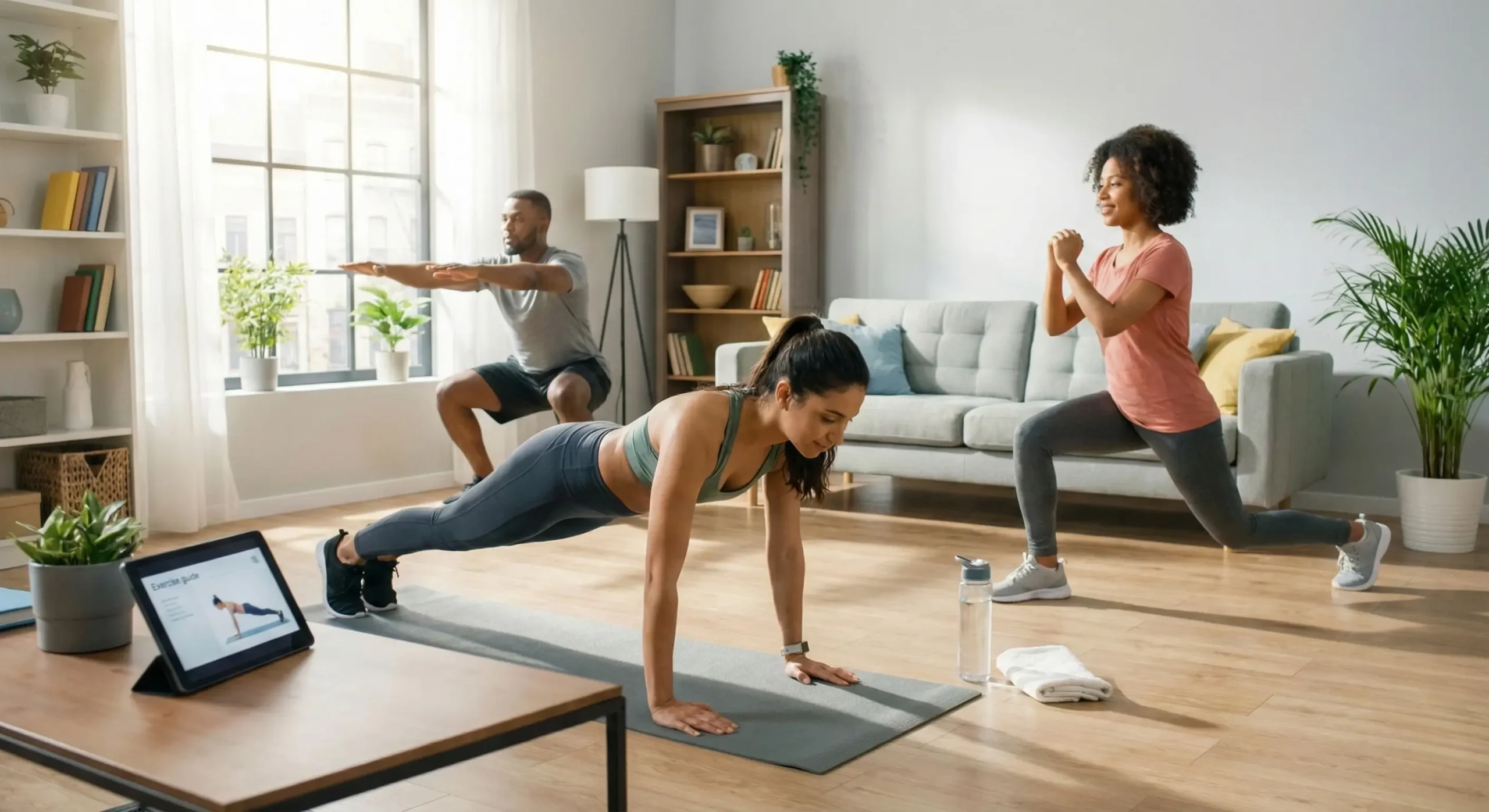
The squat is the most fundamental movement pattern in human history. It targets the quadriceps, hamstrings, and glutes while requiring significant core engagement to keep the torso upright. To perform this correctly at home, imagine you are sitting back into an invisible chair. Keep your chest proud and your heels firmly planted on the floor.
For those looking to increase the challenge, you can transition into a “Pulse Squat,” where you remain in the bottom third of the movement for several seconds. This keeps the muscles under constant tension, stimulating growth and endurance without the need for external weights. It is arguably one of the most vital inclusions in any home workout routine.
2. The Push-Up: A Complete Upper Body Laboratory
Many people view the push-up as a simple chest exercise, but when performed with strict form, it is a moving plank that challenges the shoulders, triceps, and abdominal wall. It is the gold standard for upper body functional fitness. If a full push-up is too taxing, starting with your knees on the ground is a perfectly acceptable way to build the necessary foundational strength.
The key to the push-up is the “elbow path.” Avoid flaring your elbows out like a capital letter T. Instead, keep them tucked at a 45-degree angle to your body. This protects the delicate structures of the shoulder joint and ensures the pectorals are doing the heavy lifting. This attention to detail is what separates a casual exerciser from someone who truly understands the best exercises to stay fit at home.
3. Lunges for Balance and Symmetry
While squats build power, lunges build stability and coordination. Most of us have one leg that is slightly stronger than the other, which can lead to gait issues or back pain over time. Lunges force each leg to work independently, correcting these imbalances. Whether you prefer forward lunges, reverse lunges, or the lateral variety, you are training your body to be resilient in every plane of motion.
4. The Plank: Redefining Core Strength
Sit-ups are a relic of the past. Modern sports science suggests that the core’s primary job is to resist movement, not just create it. The plank is the ultimate expression of this resistance. By holding a rigid position from head to toe, you train the deep transverse abdominis muscles that act as a natural corset for your spine. A strong core is the best defence against the lower back pain that often accompanies a sedentary work-from-life balance.
Why Functional Movement Matters More Than Ever
In 2026, our daily lives have become increasingly optimised for comfort, which unfortunately leads to physical stagnation. The best exercises to stay fit at home are those that mimic real-life movements—reaching, lifting, crouching, and balancing. This is known as functional fitness. According to research on long-term physical health from Harvard Health Publishing, maintaining these movement patterns is essential for metabolic health and cognitive function as we age.
When you perform a burpee or a mountain climber, you aren’t just burning calories; you are teaching your nervous system to coordinate complex actions. This “neuromuscular efficiency” makes you more energetic throughout the day. You will find that after two weeks of consistent home movement, the groceries feel lighter and the stairs to your apartment seem shorter.
The Cardiovascular Boost: High Knees and Mountain Climbers
You do not need a treadmill to get your heart rate into the fat-burning zone. High knees and mountain climbers are “stationary cardio” powerhouses. They require zero equipment and can be performed in a space no larger than a yoga mat. By driving your knees toward your chest in rapid succession, you trigger a spike in oxygen consumption that boosts your metabolism for hours after you finish.
Active Recovery: The Bird-Dog and Superman
Not every exercise should be a high-intensity struggle. The Bird-Dog and Superman movements focus on the “posterior chain”—the muscles along your back, glutes, and hamstrings. These are critical for anyone who spends significant time sitting at a desk. These exercises are gentle enough to be done daily but effective enough to drastically improve your posture and spinal alignment.
Common Mistakes and Challenges for Home Beginners
Even with the best intentions, it is easy to get home fitness wrong. Without a coach watching your every move, bad habits can creep in. Identifying these early is the difference between seeing progress and nursing a nagging injury. Here are the most common pitfalls encountered when searching for the best exercises to stay fit at home.
- Sacrificing Form for Repetitions: Doing fifty bad squats is significantly less effective than doing fifteen perfect ones. Quality always trumps quantity. If you feel your back arching or your knees caving in, stop the set, reset your posture, and continue.
- The “Distraction Trap”: At home, the television, the fridge, and your phone are constant sirens calling you away from your workout. To see real results, you must treat your home workout with the same respect as a professional appointment. Turn off the notifications for twenty minutes.
- Lack of Progressive Overload: People often do the same ten push-ups every day for a year and wonder why they stop seeing changes. To stay fit, you must gradually increase the difficulty. This could mean doing more reps, resting less between sets, or moving more slowly through the negative phase of an exercise.
- Ignoring the Warm-up: Jumping straight from a cold seat into high-intensity burpees is a recipe for a pulled muscle. Always spend five minutes doing light movements like arm circles and leg swings to “wake up” your joints and nervous system.
Best Practices and Actionable Tips for Success
Consistency is the secret sauce that makes the best exercises to stay fit at home actually work. You do not need to spend two hours a day training. In fact, most people find more success with shorter, more frequent sessions. Use the following checklist to ensure your home fitness journey is both productive and enjoyable.
Create a Dedicated “Movement Zone”
Psychology plays a massive role in fitness. If you try to work out in the same spot where you eat dinner or take naps, your brain will struggle to switch into “effort mode.” Clear a specific corner of a room, lay out a mat, and let that space be your sanctuary for health. When you step into that zone, your mind knows it is time to work.
Use the “10-Minute Rule”
On days when motivation is low—and those days will come—commit to doing just ten minutes of movement. Tell yourself you can quit after ten minutes if you still aren’t feeling it. Almost always, once the blood starts flowing, you will find the energy to finish the full routine. The hardest part of a home workout is simply unrolling the mat.
Focus on “Mind-Muscle Connection”
Instead of just going through the motions, focus on the specific muscle you are trying to work. When you do a glute bridge, squeeze your glutes at the top of the movement. When you do a plank, actively pull your belly button toward your spine. This conscious engagement significantly increases the effectiveness of bodyweight exercises.
Daily Routine Checklist for Home Fitness
- Hydrate: Drink a glass of water before starting to prime your joints and energy levels.
- Dynamic Warm-up: 5 minutes of joint rotations and light rhythmic movement.
- Strength Block: Choose 3 compound movements (Squats, Push-ups, Lunges) and perform 3 sets of each.
- Cardio Burst: 2 minutes of High Knees or Mountain Climbers to finish strong.
- Core Finisher: A 60-second Plank or 15 Bird-Dogs per side.
- Cooldown: 3 minutes of static stretching, focusing on the hamstrings and chest.
Final Thoughts on Staying Fit at Home
The journey toward health is not a sprint; it is a series of small, intentional choices. The best exercises to stay fit at home provide you with a toolkit for life. They allow you to maintain your vitality regardless of your schedule, the weather, or your proximity to a gym. By mastering these fundamental movements, you are reclaiming ownership of your physical well-being.
The beauty of home fitness lies in its simplicity. You don’t need a complicated plan or expensive gear. You just need to show up for yourself. Start today with a few sets of squats and a plank. Tomorrow, add a few more. Before long, these movements will become a natural part of your day, and the “gym” will simply be wherever you happen to be standing.