Table of Contents
There was a time, not so long ago, when the most advanced piece of technology in the office was a coffee machine that didn’t burn the beans. Today, the landscape has shifted entirely. We have moved past the era of simple automation and entered a phase where artificial intelligence is no longer just a tool we use, but a partner we collaborate with daily.
Understanding how AI is changing the way we work is no longer optional for professionals who want to stay relevant. In 2026, the question is no longer whether AI will affect your job, but how effectively you can orchestrate the digital assistants already sitting on your desktop. This shift is less about robots taking over and more about humans reclaiming their time for high-value thinking.
In this guide, we will explore the real-world impact of AI in the workplace in 2026, moving beyond the hype to look at the practical, day-to-day changes occurring in offices, remote hubs, and creative studios worldwide. If you have ever felt like your inbox is a sentient beast trying to eat your afternoon, you are exactly where you need to be.
The Evolution of the Digital Colleague
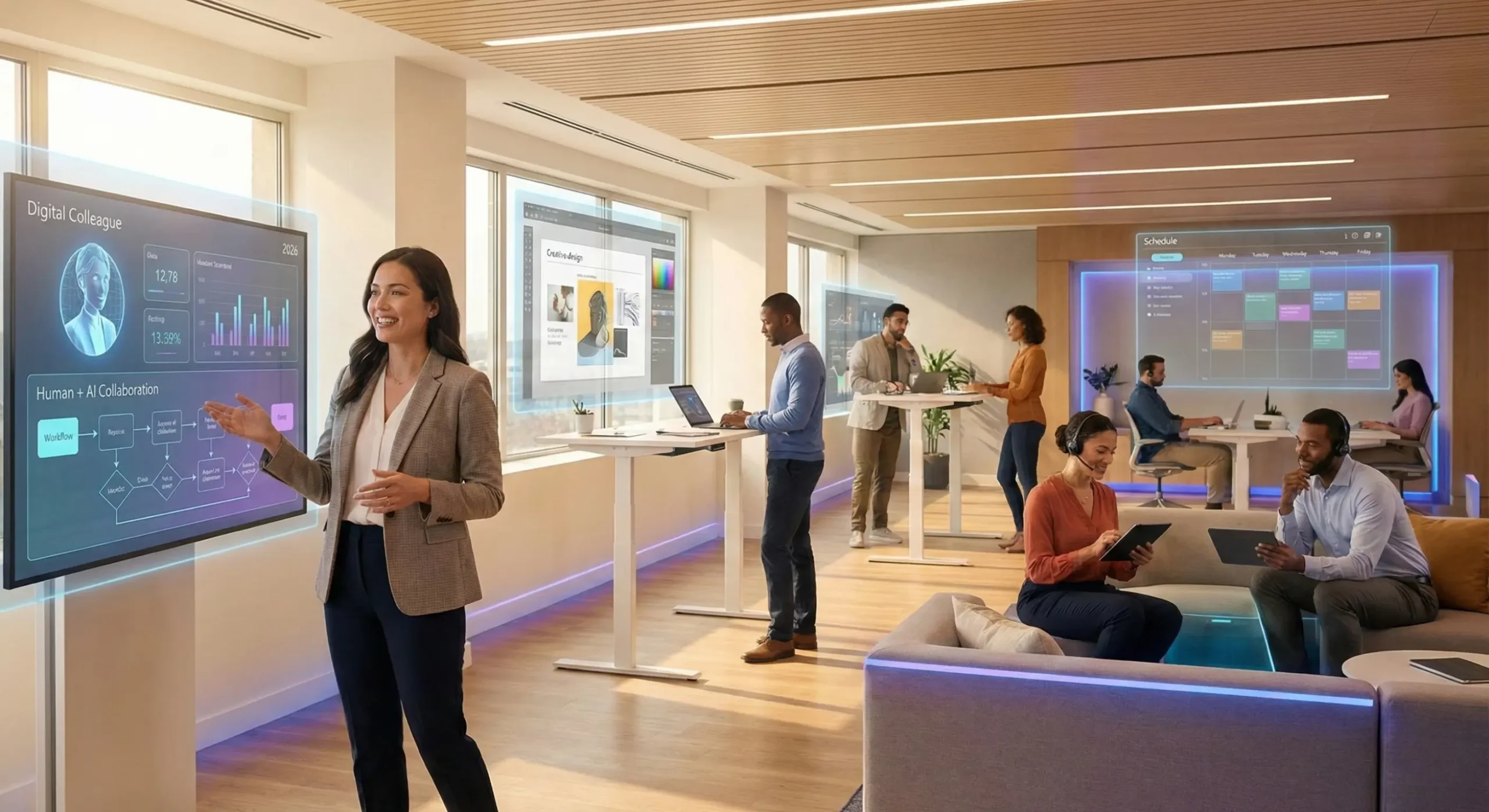
The primary way AI is changing the way we work involves the transition from passive software to active agents. In previous years, we used AI to help us write an email or summarise a long PDF. In 2026, we are seeing the rise of agentic AI—systems that can navigate complex workflows, schedule their own follow-ups, and flag project risks before a human even opens the dashboard.
This evolution is reshaping the future of work with AI by focusing on three core areas: productivity, decision-making, and specialised creativity. Rather than replacing the worker, these tools are acting as a force multiplier, allowing small teams to achieve results that previously required entire departments.
The End of the Administrative Burden
The most immediate benefit of AI in the workplace in 2026 is the steady erosion of “drudge work.” Research suggests that the average knowledge worker spends nearly a full day every week on coordination and searching for information. Modern AI tools are now handling these tasks with startling efficiency.
- Automated meeting synthesis that goes beyond transcription to identify action items and assign them to the correct team members.
- Smart inbox management that prioritises messages based on urgency and historical project involvement.
- Real-time CRM updates where AI listens to a client call and automatically populates the relevant data fields.
Enhanced Decision Intelligence
We are also seeing a major shift in how leaders make choices. Generative AI for business is now being used to run simulations and “what-if” scenarios at a scale that was previously impossible. Instead of relying solely on gut feeling or lagging quarterly reports, managers are using AI to analyse live market data and internal performance metrics simultaneously.
How Different Industries Are Adapting
The impact of AI is not uniform; it adapts to the specific needs of each sector. While a software engineer might use AI to catch bugs in real-time, a marketing professional might use it to personalise thousands of customer journeys in seconds. The common thread is the move toward human-AI collaboration, where the human provides the “why” and the AI provides the “how.”
Creative and Marketing Sectors
In the creative world, AI has become a brainstorming partner. It can generate dozens of mood boards or copy variations in the time it takes to brew a second cup of coffee. This allows designers and writers to spend more time on the strategic narrative and less time on the technical execution of minor assets.
Finance and Analytics
For finance professionals, how AI is changing the way we work is evident in the speed of audits and risk assessment. AI agents can now scan millions of transactions to find anomalies that a human eye would likely miss, transforming the role of the accountant from a data-checker to a high-level financial advisor.
Healthcare and Public Services
In healthcare, AI is assisting with triage and treatment planning. It helps doctors cross-reference patient symptoms with global medical databases in seconds. According to recent insights from Microsoft’s 2026 AI outlook, these systems are moving from research labs into real-world clinics, providing diagnostic support that improves patient outcomes while reducing the administrative load on staff.
Common Challenges: Why Transitioning Isn’t Always Smooth
Despite the benefits, the road to an AI-integrated workplace is paved with specific hurdles. Many organisations struggle because they treat AI as a plug-and-play solution rather than a cultural shift. If the foundation isn’t right, the most expensive AI tool in the world will just help you make mistakes faster.
One of the biggest mistakes beginners face is the “Black Box” problem. This happens when employees use AI but don’t actually understand how it reached a specific conclusion. Without transparency, trust breaks down, and the risk of automated errors increases. We also see significant challenges with data privacy, where sensitive company information is inadvertently fed into public models.
- The Skill Gap: Many teams have the tools but lack the specific prompt engineering and data literacy skills required to use them effectively.
- Over-Reliance: There is a danger of “cognitive atrophy,” where workers stop questioning AI outputs, leading to a decline in critical thinking and original problem-solving.
- Hidden Usage: In some workplaces, employees use AI in secret because they fear it makes them look replaceable, which prevents the organisation from building a cohesive strategy.
Best Practices for Embracing AI in Your Daily Workflow
To truly benefit from how AI is changing the way we work, you need a structured approach. It isn’t about using every tool available; it’s about using the right ones with a clear purpose. Here is a checklist of actionable steps you can apply immediately to improve your human-AI collaboration.
Audit Your Recurring Tasks
Look at your weekly schedule. Which tasks are repetitive, data-heavy, or require little creative judgment? These are your prime candidates for AI intervention. Start small by automating one specific workflow, such as your weekly status report or your meeting scheduling process.
Develop a Prompt Library
The quality of AI output is directly tied to the quality of your input. Instead of starting from scratch every time, keep a document of prompts that have worked well for you. Refine these over time to include your specific brand voice, formatting requirements, and technical constraints.
Establish Clear Guardrails
Before integrating any new workplace productivity tools, ensure you have a clear policy on data usage. Never input proprietary code, personal client data, or trade secrets into a tool unless it is a secure, enterprise-grade version with guaranteed privacy protections.
Prioritise Human Review
AI should be viewed as a “First Draft Machine.” Always assume that the AI output needs a human touch. Your value lies in the 10% of the work that the AI cannot do: the empathy, the ethical judgment, and the deep understanding of your company’s unique culture.
Final Thoughts: The Future Is Human-Centric
Ultimately, how AI is changing the way we work is by highlighting exactly what makes us human. As machines get better at processing data, humans must get better at asking the right questions. The future of work with AI belongs to those who can bridge the gap between technical capability and strategic vision.
We are not being replaced by AI; we are being replaced by people who know how to use AI. By embracing these tools as partners rather than rivals, you can shed the burden of repetitive tasks and focus on the work that actually matters—the work that requires your unique perspective, your creativity, and your judgment.
The most successful professionals in 2026 are those who stay curious, keep testing new workflows, and maintain a healthy dose of scepticism. The tools will continue to change, but the need for clear communication and human leadership remains constant. It is time to stop fearing the algorithm and start mastering the orchestration.
If you are looking for more ways to optimise your workflow, check out our recent guide on essential AI tools for project management or read about how to upskill for the AI economy to stay ahead of the curve.