Table of Contents
The transition from simple chatbots to sophisticated multimodal systems happened so quickly that most of us are still catching our breath. If you feel like you just finished mastering the nuances of prompting Gemini 1.5, only to find the landscape shifting again, you are not alone. In the tech world, “today” is often already yesterday’s news. We have moved past the era of mere text prediction into a phase where AI can see, hear, and reason across massive datasets in real time.
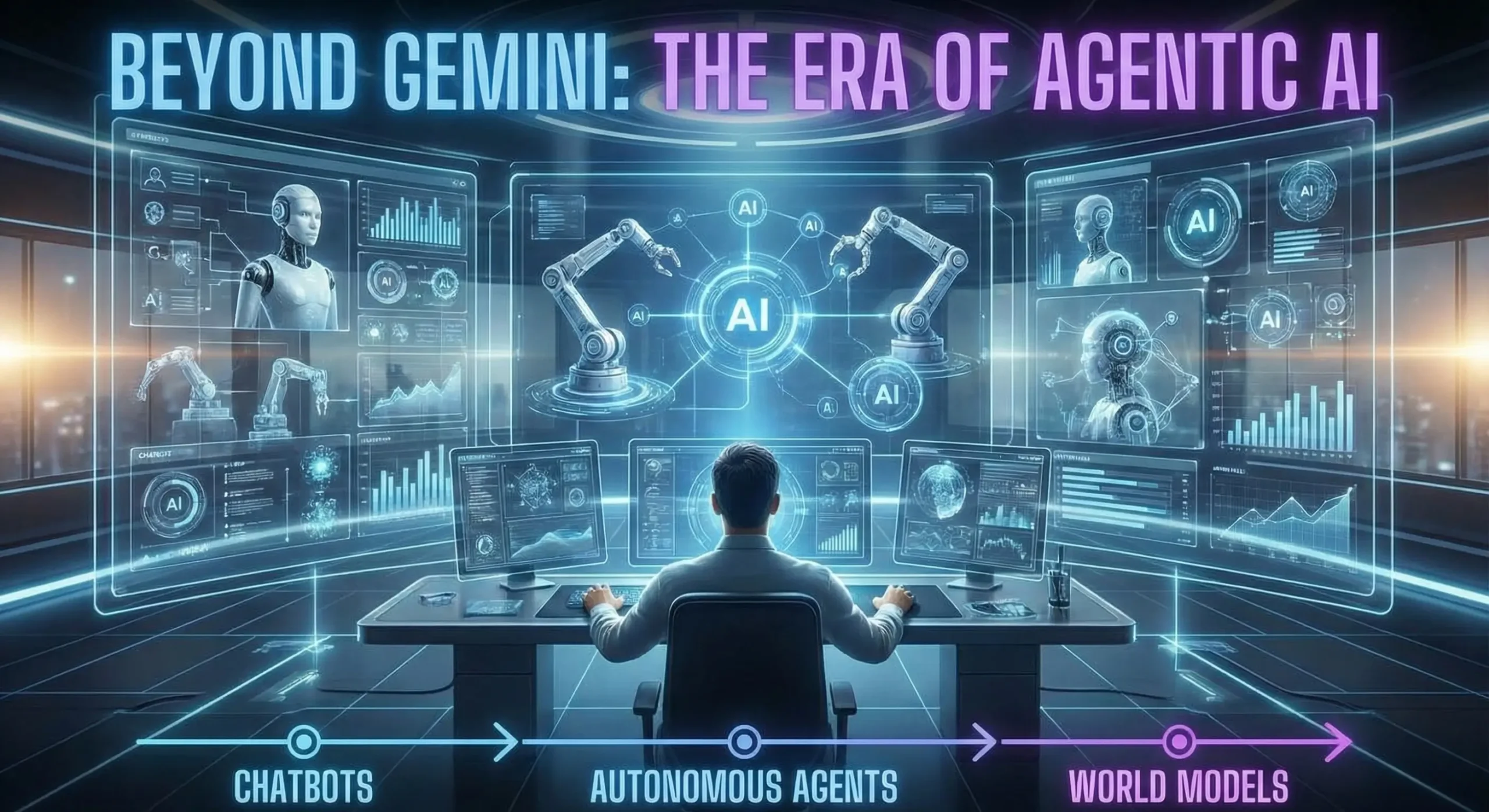
But the real question isn’t just about what Gemini can do now; it is about the structural shift waiting around the corner. We are standing at the precipice of a post-Gemini era where artificial intelligence stops being a tool you talk to and starts being a partner that acts on your behalf. This evolution from “Generative AI” to “Agentic AI” represents the single most significant leap in computing since the invention of the graphical user interface. It is less about better answers and more about autonomous execution.
As we look toward late 2026 and the inevitable arrival of systems like Gemini 4, the roadmap is becoming clear. The focus is shifting from “What can AI say?” to “What can AI finish?” For businesses, creators, and daily users, understanding this trajectory is the difference between riding the wave and being swept under it. Let’s peel back the layers of the next generation of intelligence.
The Rise of Agentic AI: Beyond the Chatbox
If 2024 and 2025 were the years of the “Co-pilot,” 2026 is officially the year of the “Agent.” For a long time, we were satisfied with an AI that could summarise a PDF or write a witty email. However, the future of artificial intelligence after Gemini is defined by agency. Agentic AI refers to systems that can plan, reason, and use tools autonomously to achieve a goal. Instead of you navigating five different tabs to book a business trip, you simply tell the agent your budget and destination. The agent then negotiates the flights, cross-references your calendar, and handles the confirmation.
- Autonomous Task Completion: Agents are now moving from providing information to executing workflows. This involves interacting with browser interfaces, clicking buttons, and filling out forms just like a human would.
- Multi-Step Reasoning: Future models are being designed to break down complex instructions into sub-tasks. If a task fails at step three, the agent self-corrects and tries a different path rather than throwing an error message.
- Native Tool Integration: We are seeing the death of the “copy-paste” workflow. AI is being baked directly into operating systems and professional software, allowing it to “see” your screen and “use” your tools without constant manual intervention.
This shift is already visible in experimental frameworks like Project Astra and the recent breakthroughs in Google Research regarding natively adaptive interfaces. These systems do not just wait for a prompt; they anticipate the next logical step in a digital process. The “chat” interface is slowly becoming a fallback for when the autonomous system needs clarification, rather than the primary way we interact with code.
Gemini 4 and the Era of Universal Fluency
While we are currently witnessing the refinement of the Gemini 2.0 and 3.0 series, the whispers about Gemini 4 suggest a model that moves beyond language entirely. Industry insiders anticipate that the next major iteration will focus on “World Models.” This means the AI isn’t just trained on text and images from the internet, but on physical physics and spatial reasoning. This is critical for the convergence of AI and robotics.
Spatial Reasoning and Physical Integration
One of the biggest hurdles for current AI is its lack of “common sense” regarding the physical world. A model might know the definition of a glass of water, but it doesn’t intuitively understand the physics of a spill. Gemini 4 is expected to integrate video-native training at a scale we haven’t seen, allowing it to simulate environments. This will power a new generation of home assistants and industrial robots that can “see” a messy room and understand the logical order of cleaning it without being programmed for every specific object.
PhD-Level Reasoning in Specialised Verticals
We are moving away from the “generalist” model that is okay at everything and toward “expert” models that are world-class at specific things. We already see this with Med-Gemini and AlphaFold. The future involves these specialised expert “brains” being able to talk to each other. Imagine a legal AI agent collaborating with a financial AI agent to audit a company’s merger, with both feeding their insights into a central coordinator. This “mixture of experts” architecture is the key to reducing hallucinations and increasing the reliability of AI in high-stakes environments.
The Death of the Search Result and the Birth of AI Mode
For decades, “searching” meant typing keywords and scanning a list of blue links. That era is effectively over. The future of AI after Gemini is transforming search into an answer engine that prioritises synthesis over discovery. Google’s “AI Mode” is becoming the default interface, where the engine doesn’t just find information; it organises it into a personalised briefing.
From Links to Actions
In the near future, search will be “transactional.” If you search for “best lawnmower for small yards,” the AI won’t just give you a list of reviews. It will offer to compare the top three based on your local hardware store’s stock, check for discounts, and put one in your cart. This changes the entire SEO landscape. Visibility is no longer about being #1 on a list; it is about being the “cited source” that the AI trusts to build its answer.
The Shrinking Consideration Set
As AI synthesises information, the “consideration set” for users is shrinking. Instead of looking at ten websites, users look at one generated summary with three or four citations. This creates a high-stakes environment for content creators. If your content isn’t authoritative enough to be the primary source for the agent, it may as well not exist for the average user. This makes brand salience and deep, original research more valuable than generic keyword-targeted filler.
Common Challenges in the Post-Gemini World
Despite the excitement, the road ahead is littered with technical and ethical potholes. Beginners and enterprises alike often stumble when they treat 2026-era AI like a 2023-era chatbot. The complexity of these systems introduces new types of failure that we are only beginning to understand.
- The “Agentic Loop” Problem: When you give an AI agency the power to take actions, you risk infinite loops or unintended consequences. An agent instructed to “find the lowest price” might spend twelve hours refreshing a page or accidentally violate a site’s terms of service if not properly governed.
- Data Privacy and “Context Leakage”: As we move toward personal AI that knows our calendars, emails, and habits, the risk of data leakage increases. Users often fail to realise that giving an agent “full access” to their desktop for productivity also gives it access to sensitive credentials.
- Over-Reliance and Skill Atrophy: There is a growing concern that as AI becomes more autonomous, the human “in the loop” becomes a “human out of the loop.” If an AI handles 90% of a software engineer’s coding, what happens when the system fails, and the human no longer understands the underlying architecture?
The mistake many people make is assuming that because the AI is “smart,” it doesn’t need supervision. In reality, the more powerful the agent, the more critical the “Commander” role becomes for the human user. We are shifting from being “writers” to being “editors” and “orchestrators.”
Best Practices for Navigating the AI Future
To stay relevant in a world dominated by agentic systems and Gemini 4-level intelligence, you need to change your strategy from “using tools” to “building systems.” Here are the actionable steps you should take now to prepare for what’s next.
1. Focus on Data Structure, Not Just Prompts
In the future, the way you organise your information is more important than the specific words you use to ask a question. Agents perform best when they have access to clean, structured data. Whether you are a business owner or a researcher, start organising your “knowledge base” into formats that AI can easily parse—such as JSON, well-structured Markdown, or specialised vector databases.
2. Master the “Orchestrator” Mindset
Stop trying to do everything yourself with a single prompt. Instead, learn how to chain agents together. Use one AI to research, a second to draft, and a third to fact-check. Understanding how to manage a “crew” of AI agents is the most valuable skill for the next five years. This involves setting clear boundaries, defining success metrics, and knowing when to intervene.
3. Prioritise “Human-Only” Value
As AI becomes a commodity, the value of “standard” output drops to zero. To thrive, you must lean into things AI cannot do: original reporting, first-hand experience, physical world interaction, and complex emotional intelligence. If a piece of content can be generated by an AI without a human ever leaving their desk, it won’t have a place in the future of search or discovery.
4. Adopt a “Privacy-First” Workflow
With on-device AI becoming the norm via chips like Google’s Ironwood TPU, look for tools that process data locally. Avoid sending sensitive business logic or personal data to “cloud-only” models whenever possible. The future belongs to the “Hybrid AI” model—where general intelligence happens in the cloud, but personal execution happens on your own hardware.
Final Thoughts: Embracing the Agentic Shift
The evolution of artificial intelligence after Gemini is not just a story of “faster” or “more accurate” software. It is a story of a fundamental change in our relationship with machines. We are moving away from the era of the computer as a passive digital filing cabinet and toward an era of the computer as an active, goal-oriented participant in our lives.
While the prospect of autonomous agents and “World Models” can feel overwhelming, the takeaway is actually quite liberating. We are being offloaded from the drudgery of the “how”—the clicking, the formatting, the basic synthesising—so we can focus on the “why.” The winners of the post-Gemini era won’t be those who can type the best prompts, but those who have the best ideas and the most strategic vision.
The future isn’t about the AI replacing the human; it’s about the AI replacing the “work” that used to get in the way of being human. As we wait for Gemini 4 and whatever follows, the best thing you can do is stay curious, stay critical, and start building your own agentic workflows today. The machines are ready to work; the question is, what will you have them do?