
Table of Contents
The Indian Premier League, commonly known as the IPL, is more than just a cricket tournament. It is a global phenomenon that blends high-stakes sport with the scale of a cinematic production. For a newcomer, the sheer volume of noise, statistics, and flashing lights can be overwhelming.
If you have ever found yourself staring at a television screen wondering why everyone is celebrating a ball that went into the crowd, or why some players wear different colored caps, you are in the right place. This guide breaks down the complexities of the league into simple, digestible sections.
Understanding the IPL does not require a lifetime of cricket knowledge. It requires an appreciation for strategy, speed, and the unique way this tournament has redefined modern sports entertainment. Let us look at how the world’s most popular cricket league actually functions.
What Exactly is the IPL?
The IPL is a professional Twenty20 (T20) cricket league in India. It was established in 2008 and has since grown into the most-attended cricket league in the world. The tournament typically takes place between March and May each year, featuring teams representing different Indian cities.
At its core, the IPL is a franchise-based system. Unlike traditional international cricket where countries play against each other, the IPL involves private owners who buy teams and recruit players from all over the globe through an annual auction. This means you will often see the captain of the Australian national team playing alongside an emerging talent from a small Indian village.
The format used is T20 cricket, which is the shortest and most explosive version of the game. While traditional Test matches can last five days and still end in a draw, an IPL match is completed in about three and a half hours, making it perfect for a modern audience with a shorter attention span.
The Fundamental Rules of T20 Cricket
To understand the IPL, you first need to grasp the basic rules of T20 cricket. The game is played between two teams of eleven players each. The objective is simple: score more runs than the opposition.
The Structure of an Innings
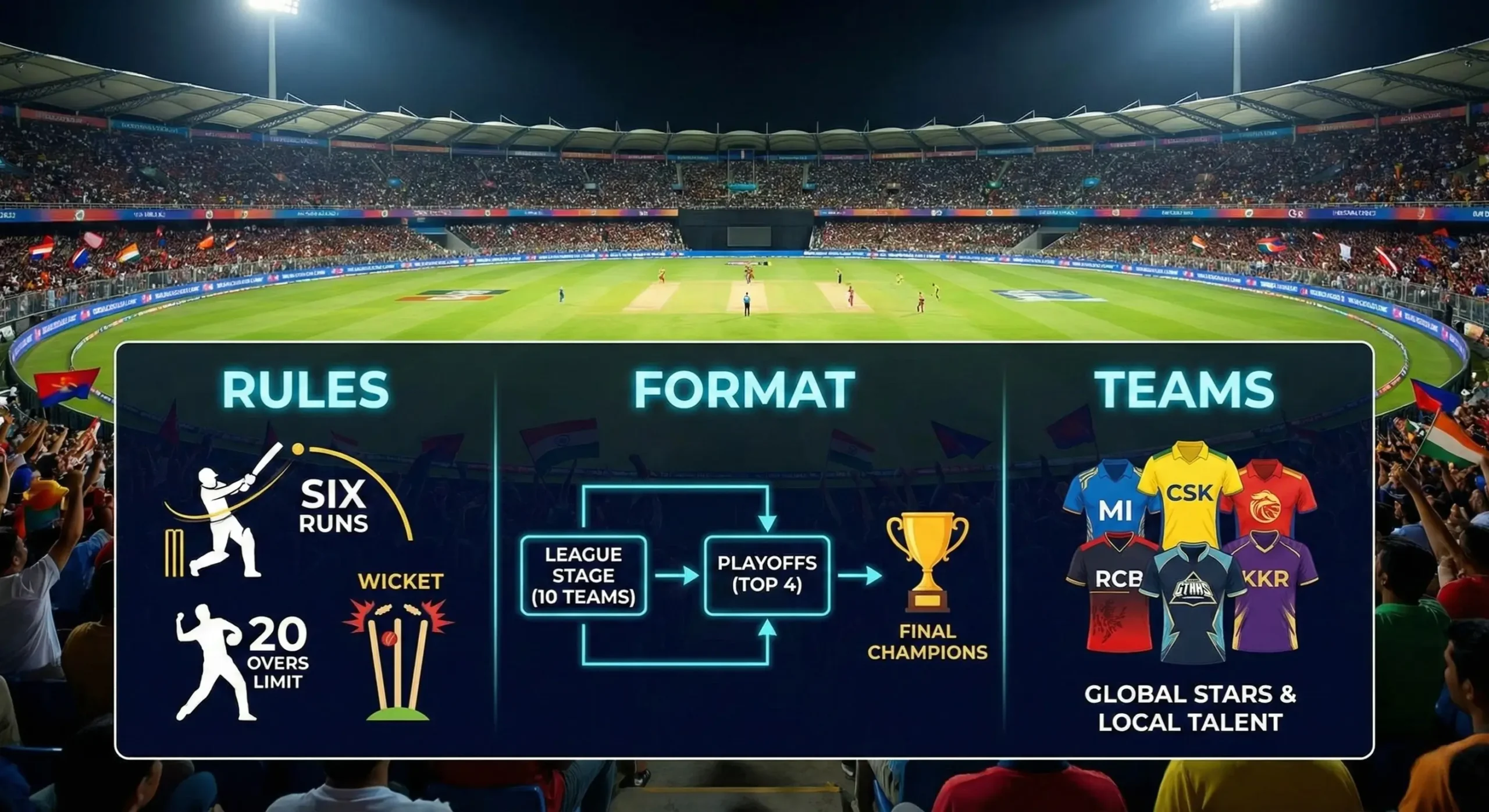
In an IPL match, each team gets one “innings” to bat and one “innings” to bowl and field. Each innings is limited to a maximum of 20 overs. An over consists of six legal deliveries bowled by a single player. Therefore, each team faces a maximum of 120 balls to score as many runs as possible.
Scoring Runs
Batters score runs by hitting the ball and running between two sets of wooden stakes called wickets. However, the fastest way to score is by hitting the ball to or over the boundary line that surrounds the field:
- Four Runs: If the ball touches the ground before crossing the boundary.
- Six Runs: If the ball crosses the boundary without touching the ground (the cricket equivalent of a home run).
- Extras: If a bowler bowls an illegal delivery, such as a “Wide” (too far from the batter) or a “No Ball” (stepping over the line), the batting team is awarded a penalty run.
Getting Out (Dismissals)
The bowling team’s goal is to restrict runs and take “wickets” (get the batters out). Once a team loses ten wickets, their innings ends, even if they have not used all 20 overs. Common ways to get out include being caught by a fielder, having the ball hit the wickets (bowled), or being “Leg Before Wicket” (LBW).
Understanding the IPL Tournament Format
The IPL does not just consist of random matches. It follows a structured path from the league stage to the grand final. Currently, the league features ten teams, and the path to the trophy is gruelling.
The League Stage
During the league stage, teams are often divided into two virtual groups. Each team plays 14 matches. They play teams in their own group twice and teams in the other group according to a specific schedule. This ensures that every team has a fair chance to accumulate points.
Points are awarded as follows:
- Win: 2 points
- Loss: 0 points
- No Result/Tie: 1 point each (though ties are usually settled by a “Super Over”)
The Playoffs: A Unique System
Unlike many tournaments that use a simple semi-final format, the IPL uses a “Playoff” system that rewards the top-performing teams from the league stage. The top four teams on the points table qualify for the playoffs.
- Qualifier 1: Played between the 1st and 2nd-placed teams. The winner goes straight to the Final. The loser gets a second chance.
- Eliminator: Played between the 3rd and 4th placed teams. The loser is out of the tournament.
- Qualifier 2: Played between the loser of Qualifier 1 and the winner of the Eliminator. The winner goes to the Final.
- The Final: The two remaining teams play for the championship trophy.
This system is highly regarded because it gives the top two teams a “safety net,” acknowledging their consistency throughout the long league season.
The Current Teams and Their Identities
As of now, there are ten franchises in the IPL. Each team has its own massive fan base, distinct jersey colours, and historical reputation. Knowing who is who helps in picking a side to cheer for.
The Heavyweights
- Mumbai Indians (MI): One of the most successful teams in history, known for their “never say die” attitude and incredible scouting network.
- Chennai Super Kings (CSK): Famous for their incredible consistency and a massive “Yellow Army” of fans. They are often seen as the most tactically disciplined side.
- Kolkata Knight Riders (KKR): Owned by Bollywood royalty, this team has a reputation for aggressive play and has won multiple titles.
The Consistent Contenders
- Royal Challengers Bengaluru (RCB): Despite not having won a trophy yet, they are arguably the most popular team due to their star-studded lineups and passionate fan base.
- Rajasthan Royals (RR): Winners of the very first IPL in 2008, they are known for their focus on young talent and data-driven strategies.
- Sunrisers Hyderabad (SRH): A team typically built around strong bowling attacks and clinical execution.
The Newest Additions and Others
- Gujarat Titans (GT): One of the two teams added in 2022, they made history by winning the title in their debut season.
- Lucknow Super Giants (LSG): The other 2022 addition, known for their balanced squad and professional approach.
- Delhi Capitals (DC): A team that has undergone a major rebranding and has become a formidable force in recent years.
- Punjab Kings (PBKS): Known for high-scoring games and a penchant for dramatic finishes.
Special IPL Concepts You Need to Know
To follow an IPL broadcast without confusion, you should be familiar with a few tournament-specific terms and rules that differ from standard cricket.
The Orange and Purple Caps
The IPL rewards individual excellence throughout the season. The player who has scored the most runs in the tournament wears the Orange Cap while fielding. The player with the most wickets wears the Purple Cap. These caps can change hands after every single match if a new leader emerges in the statistics.
The Impact Player Rule
Introduced recently to add more tactical depth, the “Impact Player” rule allows teams to substitute one player from their starting eleven at any point during the match. This allows a team to bring in an extra batter if they are losing wickets, or an extra bowler if they need to defend a score. It has fundamentally changed how coaches think about team composition.
Strategic Timeouts
During each innings, there are two mandatory “Strategic Timeouts.” These are short breaks where coaches can come onto the field to discuss tactics with the players. For viewers, it is a moment to grab a snack; for the teams, it is often where the game is won or lost.
Common Mistakes Beginners Make
When first watching the IPL, it is easy to get caught up in the spectacle and miss the nuances. Here are some common misconceptions that beginners often have.
One major error is assuming that the team with the most “star” players will always win. In the IPL, team balance is far more important than individual fame. A team of eleven solid contributors often beats a team with two superstars and nine average players. This is why the annual auction is so critical; it is a mathematical puzzle to build the best possible squad within a fixed budget.
Another mistake is misunderstanding the role of the pitch. In cricket, the dirt surface the players play on changes throughout the game. A pitch that is easy to bat on in the afternoon might become slow and difficult under the floodlights at night. Beginners often blame batters for “slow scoring” without realising the surface has become significantly harder to play on.
Finally, many newcomers ignore the “Overseas Player” limit. Each team can only have a maximum of four non-Indian players in their starting eleven. This rule ensures the development of local Indian talent and adds a layer of complexity to team selection. You cannot simply buy all the best players from around the world and put them on one team.
Tips for Enjoying Your First IPL Season
If you are planning to follow the next season, here is a practical checklist to help you get the most out of the experience.
- Pick a Team Early: The IPL is much more fun when you have “skin in the game.” Choose a team based on a city you like, a player you admire, or even just the jersey colour.
- Follow the Points Table: The race for the top four is often decided in the final week of the league. Keeping an eye on the standings makes every mid-season match feel important.
- Learn the Basics of the Powerplay: The first six overs of an innings are called the Powerplay. During this time, only two fielders are allowed outside the inner circle. It is the most explosive part of the match and usually sets the tone for the rest of the game.
- Watch the Post-Match Presentation: This is where captains explain their decisions, and the “Player of the Match” is interviewed. It is the best way to learn the “why” behind the strategies you just saw.
- Check Official Resources: For the most accurate and up-to-date information on schedules and player statistics, always refer to the official International Cricket Council website or the official IPL app.
Why the IPL Matters Globally
The IPL has changed the economy of world sport. It has proven that cricket can be a massive commercial success in a compressed format. It has provided a platform for players from smaller cricketing nations to showcase their skills on a global stage and earn life-changing salaries.
Beyond the money, the IPL has improved the quality of international cricket. Because players from different countries share dressing rooms for two months, the “mystery” of certain bowling actions or batting styles is gone. This has led to a much more competitive and high-skill environment across all forms of the game.
Final Thoughts
The Indian Premier League is a beautiful, chaotic, and thrilling journey. While the rules might seem dense at first, they quickly become second nature once you start watching the drama unfold on the pitch. Whether it is a last-ball finish or a spectacular catch in the deep, the IPL rarely fails to deliver excitement.
Now that you understand the rules, the format, and the teams, you are no longer just a spectator; you are an informed fan. The next time the sirens wail and the crowd roars, you will know exactly what is at stake.