
Table of Contents
The Indian Premier League (IPL) is often described as a carnival of cricket, but for the ten franchises involved, it is more like a high-stakes game of chess played with a calculator in one hand and a prayer bead in the other. Every year, millions of fans tune in to watch a wooden hammer decide the fate of the world’s best cricketers. Yet, behind the “sold” shouts and the flashing lights, there lies a complex web of financial regulations and strategic maneuvers that determine who wears which jersey.
Understanding how the IPL auction works is essential for any fan who wants to see beyond the surface level of the game. It is not just about who has the most money; it is about who uses their resources most efficiently under immense pressure. Whether you are a casual viewer or a budding data analyst, this guide breaks down the machinery of the IPL auction into simple, digestible parts.
The Foundation: Understanding Mega vs. Mini Auctions
Before we look at the bidding day itself, we must distinguish between the two types of auctions used in the IPL cycle. The league typically operates on a three-year cycle. At the start of this cycle, a Mega Auction is held, which essentially forces a “reset” on almost every squad. In a Mega Auction, teams can only retain a small handful of players—usually four to six—while the rest of the roster is released back into the common pool.
In contrast, the auctions held in the subsequent two years are known as Mini Auctions. These are shorter, one-day events designed for “fine-tuning.” In a Mini Auction, teams keep the majority of their core squad and only bid to fill specific gaps left by released players or injuries. The rules we see in 2026 often reflect this fine-tuning stage, where strategy is even more surgical because the number of available slots is limited.
- Mega Auction: Occurs every 3-4 years, allows for total squad rebuilding, and involves hundreds of players.
- Mini Auction: Occurs annually between mega cycles, lasts one day, and focuses on tactical additions.
Step-by-Step Breakdown of the Bidding Day
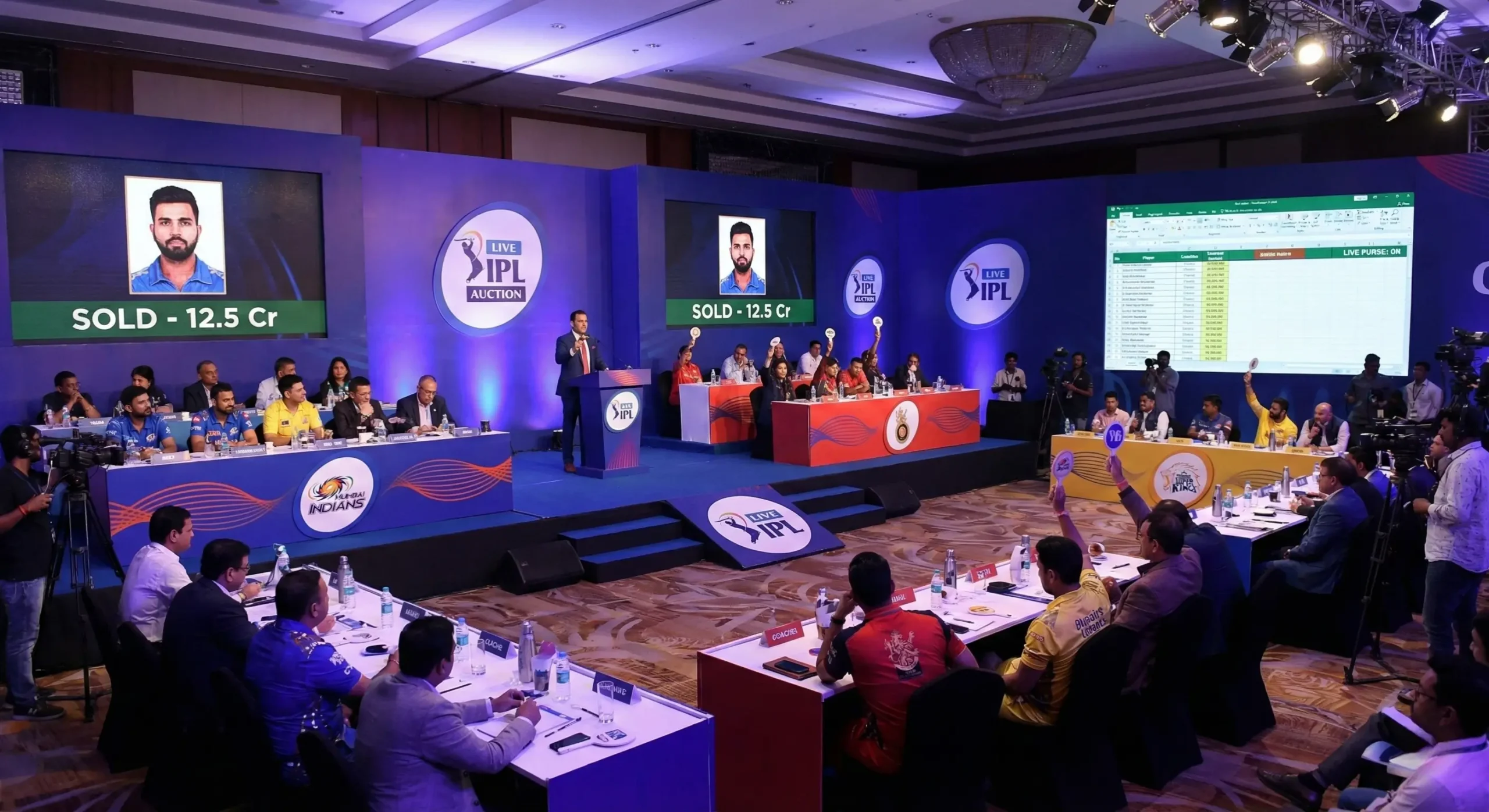
The auction day is a choreographed event led by a professional auctioneer. While it looks like a chaotic scramble for talent, it follows a very strict sequence to ensure fairness and clarity for all ten franchises seated at their respective tables. Here is how the process unfolds from the first name to the final hammer fall.
1. The Player Pool and Shortlisting
Thousands of players from around the globe register for the auction, but the list you see on television is much shorter. The BCCI (Board of Control for Cricket in India) sends the long list to the ten franchises, who then vote on which players they are actually interested in. This results in a “shortlist” of players who will officially go under the hammer. This prevents the auction from lasting weeks and ensures that the focus remains on players with actual market demand.
2. Sorting into Sets
Players are not called up in alphabetical order. Instead, they are grouped into “Sets” based on their primary skill and their status. You will typically see sets for Marquee Players, Capped Batters, Capped All-rounders, Capped Fast Bowlers, and Uncapped Players. The Marquee Set always goes first, featuring the biggest names in world cricket to set the market’s temperature early in the day.
3. The Bidding Process
When a player’s name is called, the auctioneer announces their “Base Price.” This is the minimum amount a team must pay to start the bidding. If a team is interested, they raise their paddle. The bidding then increases in fixed increments. For example, if a bid is at 5 crore, the next jump might be 20 lakh or 25 lakh, depending on the current price bracket. A player is “sold” when no other team is willing to raise the bid further, and the auctioneer bangs the hammer.
The Financial Engine: Purse and Salary Caps
Every team starts with a “Purse”—a fixed amount of money they are allowed to spend on their entire squad. For the 2025-2027 cycle, this purse has seen significant increases to keep up with the league’s growing revenue. However, the purse you see on auction day is not the full amount; it is the total purse minus the salaries of the players already retained before the auction began.
A fascinating rule introduced for the 2026 season involves a cap on overseas player salaries in Mini Auctions. To prevent runaway inflation where a single player might take up 30 percent of a team’s budget, the BCCI implemented a rule where the payout to an overseas player is capped at a certain level—often tied to the highest retention price. While the team might “bid” 20 crore, the player might only receive 18 crore, with the remainder going to a player welfare fund. Crucially, the full 20 crore is still deducted from the team’s purse, ensuring they don’t get a competitive advantage by bidding more than they can afford.
The Right to Match (RTM) Card Explained
The Right to Match, or RTM card, is perhaps the most dramatic tool in a franchise’s arsenal. It allows a team to “buy back” a player who played for them in the previous season, even if another team wins the bid. However, there is a catch. In the current cycle, the RTM rule has been tweaked to be fairer to the highest bidder.
If Team A wins the bid for a player at 6 crore, and Team B (the player’s former team) wants to use their RTM, Team A is given one final chance to raise their bid. If Team A raises it to 8 crore, Team B must match that 8 crore to keep the player. This prevents teams from simply sitting back and “stealing” players at a lower market value than what someone else was truly willing to pay. Note that RTM cards are generally reserved for Mega Auctions and are rarely, if ever, used in Mini Auctions.
Common Mistakes and Challenges
Even the most seasoned scouts and CEOs make mistakes under the lights of the auction room. These errors often stem from a mix of psychological pressure and poor data management. According to the official IPL website, squad composition must adhere to strict limits, yet teams often find themselves backed into a corner late in the day.
Emotional Bidding and the Sunk Cost Fallacy
The most common mistake is getting into a “bidding war” for a specific player and losing sight of the remaining budget. If a team desperately needs a fast bowler and misses out on their first three targets, they often overpay for their fourth target out of panic. This leaves them with very little money to fill the remaining 5 to 10 slots in their squad, forcing them to buy “filler” players who may not be match-ready.
Ignoring the “Overseas Slot” Math
Teams are allowed a maximum of eight overseas players in their squad, and only four can play in the starting XI. A common mistake is using too much of the purse on five or six high-priced overseas stars. Since only four can play, at least two expensive assets will inevitably sit on the bench, representing “dead capital” that could have been better spent on high-quality Indian domestic talent.
The Accelerated Round Fatigue
Toward the end of the auction, there is an “Accelerated Round” where unsold players are brought back at the request of franchises. Because this happens late in the evening, some teams lose focus or have already exhausted their purse. Smart teams often save 2 to 3 crore specifically for this round to pick up “steals”—experienced players who didn’t find a buyer earlier but can provide immense value as backups.
Best Practices: How Teams Win the Auction
Winning the IPL on the field starts with winning the auction in the boardroom. The most successful franchises, like Chennai Super Kings or Mumbai Indians, typically follow a specific set of best practices that any fan can look out for during the live broadcast.
- Prioritize Indian Core: Since seven out of the eleven players in a lineup must be Indian, the smartest teams spend heavily on reliable Indian capped players first.
- The “Base Price” Strategy: Scouting “uncapped” Indian talent (players who haven’t played for the national team yet) allows teams to find future stars at a base price of 20 to 50 lakh, saving the big money for marquee names.
- Budget Buffering: Always keep a small portion of the purse—roughly 5 to 10 percent—for the final hour of the auction to avoid being outbid for essential squad-fillers.
- Role-Based Shopping: Instead of buying the “best” player available, buy the player that fits the specific vacancy. If you have a great opener, don’t bid for another one just because he’s famous; buy a finisher.
Final Thoughts: The Strategy Behind the Spectacle
The IPL auction is a masterclass in supply and demand. It is easy to look at the massive price tags and think of it as mere extravagance, but every crore spent is a calculated risk. The system is designed to create parity; by giving every team the same budget and the same rules, the league ensures that no single team can dominate simply by having deeper pockets than the others.
As you watch the next auction, pay attention to the remaining purse of each team and the number of slots they still need to fill. You will quickly see that the real “winner” isn’t the team that signs the most expensive player, but the team that builds a balanced squad capable of surviving a long, grueling season. For internal insights on how these squads perform after the bidding ends, you might want to read our analysis on IPL team performance metrics.
The hammer may fall in a split second, but the strategy behind it takes months of preparation. Next time you see a bidding war, you will know exactly why that extra 25 lakh matters so much.